
How to Start a Startup: From Idea to Innovation
Albert Wenger · Managing Partner, Union Square Ventures
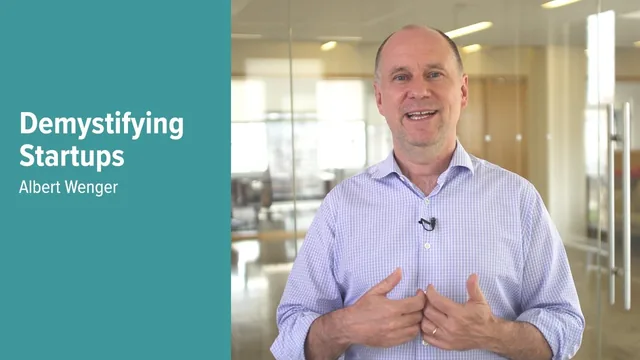
A Union Square Ventures partner compresses hundreds of startup autopsies into 56 minutes, trading depth for a fast, usable map of the earliest decisions.
Albert Wenger has sat on the investor side of more startup pitches than almost anyone teaching on Skillshare, and this course reads like a condensed version of that pattern-matching. Across ten short lessons it moves in a straight line: where ideas come from, how to pick co-founders, how to validate before building, how to build a minimum viable product, how to tell if it is working, when to hire, and why so much of this goes wrong. The arc mirrors the actual sequence a founder faces, which makes the course easy to follow even for someone who has never thought about starting a company.
The idea-generation lesson is the strongest of the set because it argues by counterexample as much as by example. Wenger names four legitimate sources, scratching your own itch, meeting a clearly identified need, learning from a failure, and applying a technological breakthrough, and grounds each in a specific company: Delicious born from Joshua Schachter's own bookmarking frustration, Etsy emerging sideways out of a crafting community project, Stripe replacing the clunky merchant-agreement process of older payment gateways. He is just as specific about what does not work, dismissing brainstormed lists and consultant-style option-mapping as approaches that produce ideas nobody feels committed enough to survive on when things get hard.
Where the course earns its keep
The validation lesson is the practical core of the class, and it is the one piece worth the full 56 minutes on its own. Instead of vague advice to "talk to customers," Wenger gives a specific mechanism: build the cheapest possible mock-up, a single webpage, a wireframe, even a fake demo video, and show it to one stranger at a time. He explains precisely why a group setting fails, because focus groups get hijacked by whoever likes to talk, and why friends and family fail, because nobody wants to be the one pouring cold water on an idea. That single technique, tested against a dozen strangers found through a Craigslist ad rather than a formal survey, is more actionable than most of what surrounds it.
The MVP lesson builds on that same instinct toward cheapness and speed, citing Etsy's two-and-a-half-month build and Airbnb's decision to send photographers to hosts rather than engineer an automated fix. The lesson to take something away when adding a feature, rather than only ever adding, is a useful discipline stated plainly.
Where it thins out
Because the whole class runs under an hour, several lessons that deserve real depth get compressed into a few illustrative anecdotes and a rule of thumb. Hiring gets one clear idea, the "always be collecting candidates" habit, but no real framework for interviewing or comparing candidates. Risk and failure leans on an Aristotelian golden-mean framing that is memorable but thin, restating that founders can err in either direction on hiring, fundraising, and customer listening without giving much guidance on where the line actually sits. The course also assumes a fairly specific type of startup throughout, technology-enabled and built to grow fast enough to need investment capital, so anyone building a bootstrapped service business will find some of the advice does not transfer.
This works best as an orientation session before a founder starts making decisions, not as a working manual to return to once the company exists.
The standout
The rule to validate an idea by showing a bare-bones mock-up to one stranger at a time, never a group and never friends or family, because people react honestly to a concrete object but give meaningless answers to an abstract pitch.
What you will learn
- Four repeatable sources of startup ideas: scratching your own itch, meeting a clearly identified need, working around a failure in an existing solution, and applying a technological breakthrough to a problem
- Why brainstorming lists and chasing funded trends rarely produce ideas founders can stay committed to
- How to validate an idea with a cheap mock-up shown one person at a time, instead of surveys or focus groups
- How to build a minimum viable product fast using existing components and outsourced individual contributors instead of agencies
- How to read both quantitative usage data and qualitative one-on-one observation to judge product market fit
- Practical guidance on vesting founder equity, splitting it among co-founders, and timing the first employee hire
Best for: A first-time founder or curious professional who wants a structured mental model of the idea-to-MVP journey before committing real time or money.
Skip it if: Anyone who already has a co-founder, a validated idea, or has read standard lean startup material, since the ground covered will feel familiar and under-detailed.