
How to Paint: Watercolor Loose Florals
Audrey Moon · Watercolorist and Modern Calligrapher
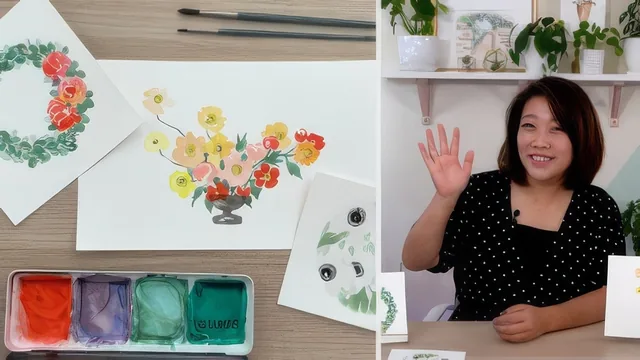
A well-structured beginner watercolor course that trades botanical accuracy for expressive brushwork, color theory, and three finished projects.
A Grounded Path Into a Loosely Held Style
Audrey Moon's class opens with a clear thesis: loose floral painting means working without pencil outlines, relying instead on brushstrokes and gesture to suggest a flower rather than render it precisely. That framing matters, because it sets expectations early and prevents the frustration of a beginner expecting a botanical drawing lesson. The course is explicit that observational sketching is out of scope, which is an honest boundary rather than an omission that surprises viewers later.
The supplies lesson is unusually thorough for a 103-minute class. It covers brush shapes and sizes, paper weight and texture (cold press versus hot press), student grade versus artist grade paints, and palette materials from metal to ceramic, all with specific brand mentions and practical maintenance advice like not leaving brushes standing in water. Beginners often stall out on equipment confusion, and this lesson removes that friction efficiently.
From there the structure builds logically: six foundational techniques, then a full color wheel mixed from just three primaries, then color scheme theory, then leaves, then flowers, then three complete projects. Each stage feeds the next. The techniques lesson in particular is the backbone of the class. Wet-on-dry, gradient wash, wet-on-wet, dry brush, variegated wash, and layering are each demonstrated with a concrete exercise, such as painting a strip of one-inch squares to observe how water-to-paint ratio changes value. That single exercise does double duty, teaching brush control and value theory at once.
Where the Course Delivers
The flower-painting lesson is generous, covering seven distinct shapes, sunflowers, black-eyed Susans, tulips, dahlias, poppies, anemones, roses, and peonies, each broken into a repeatable stroke pattern. The advice to think in terms of brushstroke and gesture rather than flower anatomy is consistent with the class's stated philosophy and gives the lessons a coherent throughline instead of feeling like a checklist of unrelated demos.
The three projects, a complementary lamb's-ear-and-peony wreath, an analogous poppy arrangement, and a monochromatic anemone composition, are useful because they force application of the color theory taught earlier rather than leaving it abstract. Watching a color scheme translate into an actual bouquet is more instructive than the color wheel exercise alone.
Where It Falls Short
The class is candid that sketching and observational drawing are excluded, but that also means students get no guidance on composition beyond loose verbal cues like leaving gaps for focal flowers. Anyone hoping to eventually draw arrangements with intentional structure will need a separate resource. The pacing also leans heavily on demonstration; there is real information about pigment names and mixing ratios, but a viewer without prior painting exposure may need to pause and repeat sections to absorb it. Finally, because the class deliberately avoids realism, students seeking botanical precision or a more technical rendering approach won't find it here.
Overall this is a competent, well-sequenced beginner course that respects its own scope. It does not overreach into intermediate territory, and what it promises, a working knowledge of watercolor basics applied to loose floral painting, it delivers.
The standout
The six basic techniques lesson, especially the gradient wash and variegated wash drills, gives a fast, hands-on feel for controlling water-to-paint ratio that underpins everything painted afterward.
What you will learn
- How to mix a full color wheel from just three primary paints and identify warm versus cool hues
- Six core watercolor techniques: wet-on-dry, gradient wash, wet-on-wet, dry brush, variegated wash, and layering
- How to paint loose leaves, stems, and six flower types (sunflower, tulip, dahlia, poppy, anemone, rose, peony) using gestural brushstrokes
- How to apply complementary, analogous, and monochromatic color schemes to a floral composition
- How to source and ethically adapt reference photos from royalty-free sites instead of copying directly
- How to complete three real-time floral arrangement projects from sketch to finished piece
Best for: A true beginner who owns basic watercolor supplies and wants a structured, low-pressure path from color mixing to a finished loose floral piece.
Skip it if: Anyone wanting botanically accurate flower anatomy, sketching-based composition, or techniques beyond a beginner skill level.