
How to Paint a Watercolor Floral Wreath
Caitlin Sheffer · Watercolor Artist & Designer
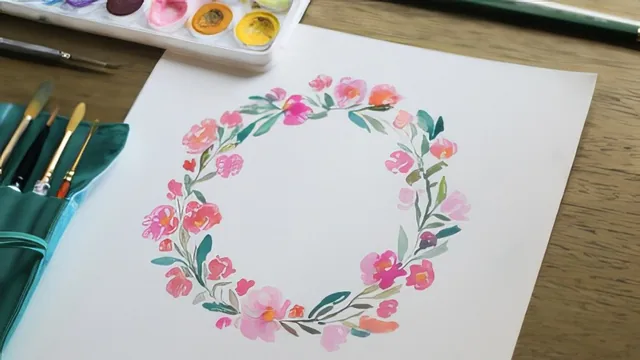
A 27-minute demo builds one modern floral wreath from three brush sizes and inexpensive paint, no prior watercolor experience needed.
What the course actually covers
This is a short, single-project class built around one outcome: a circular floral wreath in pink and green, painted in real time from a blank sheet of cold-press paper. The structure is linear and practical. An introduction sets expectations, a supplies segment runs through brushes, paint, and paper, a brief practice segment isolates the core brushstroke, and the final two segments walk through painting the wreath itself, first the greenery, then the flowers. There is no detour into color theory, composition principles as a standalone topic, or alternate wreath styles. It is one path, followed once, start to finish.
The technical backbone is a single skill: pressure control with a round brush. The practice segment has the instructor demonstrate a thin line under light pressure, a thick line under heavy pressure, and an alternating fat-thin-fat stroke that becomes the leaf shape. That one stroke, repeated with size 1, 5, and 10 round brushes, is what builds every leaf and most petals in the finished piece. It is a genuinely useful drill because it is the kind of muscle memory that transfers well beyond this specific wreath, and demonstrating it before the real painting begins is a sound teaching choice.
Where it delivers and where it thins out
The wreath-base segment is the most substantive part of the class. It covers tracing a faint pencil guide with an inverted bowl, building stems and leaves in a loose vine pattern, leaving intentional gaps for flowers, varying green mixtures with touches of yellow and red for a more natural look, and even a small troubleshooting moment about lifting excess water with a paper towel. That mix of technique and real-time problem-solving is where the class earns its keep.
The flower segment is looser and more improvisational, which is consistent with the course's stated modern, gestural style but leaves less concrete instruction to hold onto. Petal shapes are described in general terms, such as loading a brush with water and pigment and pulling toward a center point, and placement is guided by a clock analogy rather than a repeatable rule. A viewer hoping for distinct techniques for different flower types will not find them here. The class commits to one loose floral vocabulary and repeats it with color variation rather than range.
At 27 minutes, the course does not pretend to be comprehensive, and it should not be judged as if it were. It teaches one project well enough to complete, with enough narrated reasoning behind each brush choice that a beginner can follow the logic rather than just copying strokes blindly. What it does not offer is much room to adapt the technique to a different composition, a different color palette's specific mixing logic, or a second attempt with meaningfully different guidance. Two supplementary PDFs are mentioned as references for flower shapes, which somewhat offsets the flower segment's looser instruction, though the video itself remains the primary teaching vehicle.
For a true beginner looking for one satisfying, low-cost project to get comfortable holding a brush and mixing color, this delivers exactly what it promises. Anyone looking to develop a broader watercolor floral vocabulary will need to look elsewhere after finishing it.
The standout
The pressure-based brushstroke drill, thin line, thick line, then an alternating fat-thin-fat stroke, is the single technique the whole wreath depends on and is worth practicing on its own.
What you will learn
- How to trace a faint pencil guide circle using an inverted bowl as a template
- How to vary brush pressure on a round brush to produce thin, thick, and tapered leaf strokes
- How to mix earthy greens by dropping in small amounts of yellow or red rather than using flat pigment
- How to build a wreath base with vine-like stems and layered foliage before adding flowers
- How to paint loose, gestural petals by loading a brush with water and pigment and pulling toward a center point
- How to place flowers evenly around a circular composition using a clock-position method
Best for: A true beginner who owns basic supplies and wants a single guided project to build confidence with a brush before attempting freehand floral work.
Skip it if: Anyone who already paints watercolor botanicals or wants in-depth color theory, wet-on-wet technique, or multiple composition options.