
How to Learn: Strategies for Starting, Practicing & Mastering the Skills You’ve Always Wanted
Mike Boyd · Learner of things... teacher of things
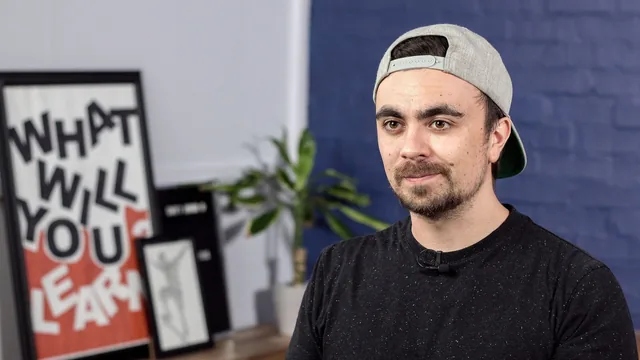
Mike Boyd distills three years and 50 learned skills into an honest 38-minute framework for starting fast and quitting less.
A method built from one person's spreadsheet of trial and error
Mike Boyd's class is not a course about any single skill. It is a course about the process he built while filming himself learning 50 different ones, from a six-hour kickflip to shattering a wine glass with his voice. That origin story does useful work early on: it establishes credibility through repetition rather than credentials, and it sets up the class's central move, treating the brain as a trainable muscle instead of a fixed container. The neuroplasticity reframe is not new science, but Boyd applies it concretely, arguing that a frustrating hour on the violin builds the same kind of "fitness" that transfers to unrelated tasks like video editing. Whether or not that transfer claim holds up rigorously, it functions well as a motivational device for someone standing at the bottom of a learning curve.
The middle lessons are where the class earns its keep. "Practicing Smart" is the strongest section, walking through four specific tactics: shrinking the barrier to practice by placing the object of practice in your sightline (a Rubik's Cube left on a desk), routing a workout into an existing commute rather than carving out new time, running Pomodoro cycles of roughly 25 minutes, and blending fun practice with deliberate practice so morale survives the boring reps. The muscle-up and violin examples ground each idea in something specific rather than leaving them as abstractions. The self-diagnosis technique that follows, isolating one variable in your technique at a time instead of overhauling everything at once, is the class's single most transferable idea and the one most likely to still be useful months later.
"Pushing Through the Dip" covers the psychological trough between novelty and competence, with advice to acknowledge the dip as expected, shorten practice sessions to avoid burnout, and take rest days when a physical skill plateaus from fatigue rather than a technique problem. The goal-setting lesson closes the arc by admitting that early goals are often miscalibrated, using Boyd's own failed attempt at a back flip on the ground as a cautionary example, and recommending that goals shift as competence grows rather than staying fixed.
Where the class falls short is depth and originality. Passion, grit, plasticity, Pomodoro, and goal-setting are each given a single pass, cited loosely (a nod to Angela Duckworth's research substitutes for real engagement with it), and left there. There is no exercise physiology, no memory science beyond the muscle analogy, and no skill-specific guidance, which is by design but limits how far the class can take a serious learner. The project template for journaling goals is a nice structural touch but is not covered in enough detail to function as a standalone tool.
This works best as a short reset for someone who has quit two or three hobbies recently and wants a vocabulary and a few concrete habits for trying again, not as a deep study of learning theory.
The standout
The self-diagnosis method, changing exactly one variable in your technique at a time and monitoring the result, gives a repeatable way to troubleshoot a stalled skill without a coach.
What you will learn
- How to set an unambiguous, bite-sized starting goal and track it with a progress journal
- Reframing struggle using the neuroplasticity model, so difficulty reads as training rather than a setback
- Reducing friction to practice by embedding a skill into an existing routine (the desk-Rubik's-cube method)
- Applying the Pomodoro Technique to physical or mental skill practice, with recommended cycle lengths
- Blending fun practice with deliberate, isolated practice to keep motivation up while still improving weak points
- Self-diagnosing technique problems by changing one variable at a time instead of several at once
Best for: Adult beginners and hobbyists who keep abandoning new skills and want a practical mindset and practice system, not a subject-specific tutorial.
Skip it if: Anyone looking for skill-specific instruction, academic depth on learning science, or techniques beyond what a well-read hobbyist could already describe.