
How to Get a Job: A Step-by-Step Guide | Learn with Glassdoor
Scott Dobroski · Director, Corporate Comms at Glassdoor
A former job-seeker turned Glassdoor communications lead compresses the entire hiring cycle into ten lessons, and the salary-negotiation script alone is worth more than most standalone negotiation courses charge for.
Scott Dobroski runs this course like a checklist made human: ten short lessons that trace the entire hiring funnel in order, from figuring out what job title to even search for through to deciding whether to accept an offer. The pitch up front is that nobody teaches this in school, and the course tries to fill that gap methodically rather than with motivational filler.
The strongest material sits at the two ends of the process. The opening research lesson makes a genuinely useful pivot: instead of searching by job title, list your technical skills, job-functionality skills, and soft skills first, then let those lead you to titles you might not have considered (the copywriter-to-content-marketer example lands well). It also pushes a discipline most job seekers skip, which is researching the employer itself, ranked by location, values, financial picture, employee reviews, and benefits, before ever applying, so you are not wasting your own time or the recruiter's on a company you would turn down anyway.
The resume and cover letter sections are the most tactical
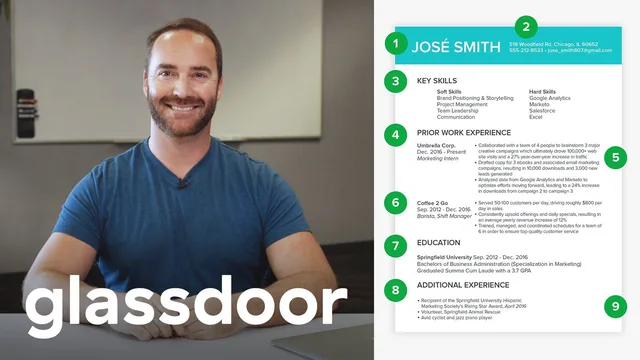
The resume lesson breaks into nine concrete elements: margin and font specs, a case against the objective statement, keyword-matching for applicant tracking systems, quantifying accomplishments instead of listing responsibilities, and a sliding rule for how many bullet points to give recent jobs versus old ones. It is the kind of granular, checklist-ready advice that a viewer can apply the same afternoon. The cover letter lesson is thinner by comparison. It correctly warns against simply restating the resume and gives one memorable anecdote about a candidate who mentioned the company's Halloween photo, but it spends less time on structure than the resume section does, so it reads more like a set of principles than a template.
Interviewing and negotiation carry the back half
The interview lessons cover phone screens and in-person interviews with practical staging details, arrive fifteen to thirty minutes early but wait in the car, keep phone-screen answers concise, never ask an interviewer how to change teams or how to get their job. The negotiation lesson is the standout of the course. It sorts offers into three buckets (great as-is, mostly good but off on pay or scope, or way off) and gives an actual sentence-level script for countering a lowball number, paired with the requirement to back any counter-figure with at least three researched reasons rather than a gut-feeling number.
Where the course thins out is anything past the offer. The final lesson on starting a new job is five generic bullet points (listen, meet stakeholders, ask questions) delivered in under two minutes, a noticeably weaker close after forty-plus minutes of specifics. The course is also unmistakably US-centric in its numbers (five million open jobs, four percent unemployment, a twenty-four-day average hiring window) and leans on Glassdoor's own tools as the implicit research method throughout, which is reasonable given who is teaching it but worth knowing going in. For a first-time or mid-career job seeker who wants one coherent process instead of a dozen scattered articles, it delivers real value, particularly in the resume and negotiation sections, even though the ending arrives underweight relative to everything that came before it.
The standout
The negotiation lesson's exact phrasing for countering a lowball offer, paired with the rule to always back a counter-number with at least three concrete reasons, is the single most usable script in the course.
What you will learn
- How to reverse-search job titles by starting from your own skill set rather than a fixed title, so you surface adjacent roles you would not have thought to search for
- A nine-point resume anatomy covering margins and font size, contact placement, cutting the objective statement, keyword matching for applicant tracking systems, and quantifying accomplishments with action verbs
- How to write a cover letter that adds a personal anecdote and a direct call to action instead of restating the resume
- A seven-day follow-up cadence for unanswered applications, including how to find a contact's email pattern and who to approach first
- How to run a phone screen and in-person interview, including a two-part answer structure for weakness questions and which questions to never ask an interviewer
- A specific salary-negotiation script that separates 'everything is great', 'mostly good but off on pay or role', and 'way off' offers, plus how to price non-cash perks like remote days and vacation
Best for: Anyone actively job hunting who wants a structured, research-driven process rather than scattered tips picked up from articles and friends.
Skip it if: Experienced negotiators, senior executives job hunting through recruiters and personal networks, or anyone hoping for niche industry or country-specific guidance beyond general US hiring norms.