
How to Draw: A Beginner’s Guide - Part 1 of The Drawing Laboratory
Brent Eviston · Master Artist & Instructor
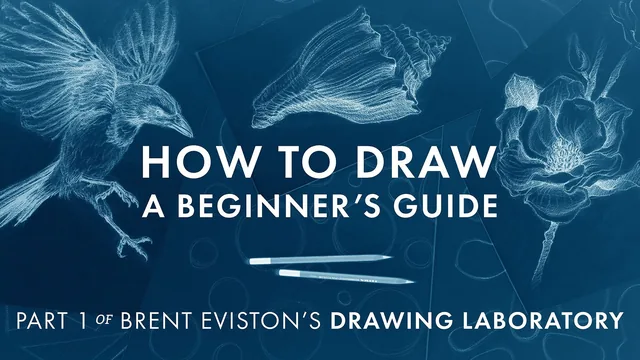
A genuinely structured shape-first method for beginners, though 357 minutes of one instructor's voice with no live feedback will test patience.
A method, not just encouragement
Brent Eviston's How to Draw: A Beginner's Guide opens with a deliberate reframing: drawing is a learnable skill, not a talent, and the lumpy, revised lines visible in Michelangelo and Rubens sketches are proof that even master draftsmen never got a form right on the first pass. That framing sets up the course's real subject, which is not inspiration but process. Eviston teaches a specific, repeatable sequence: lay down extremely light construction lines, simplify the subject into basic shapes, correct those shapes against a reference, then progressively commit to darker contours, texture, and value. It is a system, and the course spends most of its runtime drilling the mechanics of that system rather than delivering isolated tips.
The early lessons are almost stubbornly narrow. An entire lesson is devoted to nothing but the overhand pencil grip and drawing figure-eights lightly enough to be visible up close but invisible from ten feet away. That kind of patience pays off later, when the same light-line habit becomes the backbone of the "envelope" and "block-in" techniques used to rough out proportions on a full subject. Circles, ovals, and straight-edged shapes get their own dedicated lessons before the course ever asks a student to draw something recognizable, which is a slower on-ramp than most beginner drawing content but a more disciplined one.
The five-question routine
The strongest single piece of instruction is the five-question routine applied while drawing the cardinal demo: what is the next biggest shape, what is its axis, how big should it be, where should it go, and what changes need to be made. Eviston walks through this checklist shape by shape, comparing a rectangle for a tail to an oval already on the page, then a head, a beak, an eye, always in relation to what has already been placed rather than in isolation. It turns "observe your subject carefully" from vague advice into an actual procedure a beginner can run through consciously until it becomes automatic. This, more than the shape vocabulary itself, is what separates the course from generic how-to-draw content.
The demo lessons, where the shape method gets applied start to finish on a cardinal and later a botanical subject, are where the course earns its keep. Watching the full arc from envelope to block-in to contour to shading makes the earlier, more tedious lessons click into place. The materials and setup lesson at the end is useful but low-stakes, covering pencils, paper, erasers, and easel positioning in a way that will matter more to some students than others.
Where it falls short
The course's central limitation is structural rather than pedagogical: it is a monologue. There is no feedback loop, no critique of student work, and no way to know if a beginner's shapes, axes, or proportions are actually correct beyond self-assessment against a reference image. For a subject as feedback-dependent as drawing, that absence matters more than in most skill categories. The pacing is also uneven. The grip and light-line lessons run long relative to their content, while the transition into detail, texture, and value near the end moves faster than the foundational material that precedes it, leaving the "finishing" half of the drawing process comparatively underexplained.
Six hours is a real commitment for a beginner-level course, and much of that length comes from repetition across multiple demo subjects rather than new concepts. Students who already grasp basic shape construction will find long stretches redundant. But for someone starting from zero, the redundancy functions as practice reinforcement, and the shape-based method itself is sound enough to justify sticking with it through the slower stretches.
The standout
The five-question shape evaluation routine, repeated shape by shape through the cardinal demo, gives beginners a concrete, repeatable decision process instead of vague encouragement to 'observe closely.'
What you will learn
- How to hold a pencil using the overhand grip for varied, softer lines versus the tripod grip for dark, precise marks
- How to break any subject down into basic shapes (circles, ovals, rectangles, triangles) before adding detail
- How to use the 'envelope' and 'block-in' methods to establish a subject's overall proportions before committing to specifics
- A five-question evaluation routine (biggest shape, axis, size, placement, changes needed) for building a drawing shape by shape
- How to progress from light, disposable construction lines to solid contours and finally to texture, detail, and value
- Basic materials selection and drawing station setup, including how to keep paper perpendicular to your line of sight
Best for: True beginners who have never drawn seriously and want a methodical, shape-based system rather than loose inspirational tips.
Skip it if: Anyone who already understands basic shape construction and proportion and wants faster movement into rendering, anatomy, or advanced technique.