
How to be Happier - Stoicism Masterclass
Ali Abdaal · Doctor + YouTuber
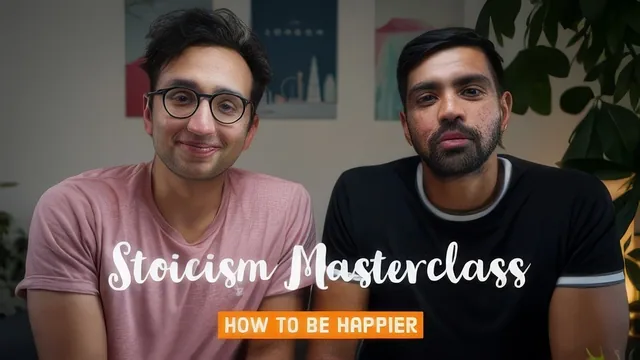
Two hosts translate five stoic techniques into daily habits, though the back half drifts into anecdote and self-promotion.
This course sets out to do one specific thing: take five stoic principles and turn each into a technique you can use before the day is over. It largely succeeds at that narrow goal, and it is honest about being an introduction rather than a scholarly treatment.
Structure and technique
The first half moves through the Dichotomy of Control, Premeditating Adversity, Voluntary Discomfort, A View From Above, and Journaling, one lesson each, with a worksheet attached to every one. The control exercise asks the viewer to log a frustrating situation in two columns, what was in their control and what wasn't, and is presented as the foundation the other four build on. Premeditating Adversity borrows the language of exposure therapy, rehearsing a bad outcome each morning so it stings less if it happens. Voluntary Discomfort is framed as the physical version of that same idea, cold showers and an extra rep at the gym standing in for genuine hardship. A View From Above is a zoom-out visualization, picturing yourself from the corner of a room, then from outside the building, then from orbit, to shrink a problem's apparent size. Journaling closes the loop by giving the other four a place to live day to day.
The second half applies those five tools to specific domains: anger, criticism, money and status, relationships, and acceptance. This is where the course becomes noticeably more anecdotal. The anger lesson does introduce a genuinely useful distinction, the "proto-passion" (an instinctive flash of feeling) versus the story a person tells themselves about it afterward, which is the most conceptually interesting idea in the back half. The criticism lesson leans on a single movie reference to make its point rather than developing the underlying stoic argument further. The wealth and relationships lessons repeat the same handful of quotes from Marcus Aurelius and Seneca already used earlier, which starts to feel like padding rather than depth.
What works and what doesn't
The teaching device of pairing a doctor-YouTuber with a philosophy-and-theology graduate works reasonably well: one host supplies the ancient sourcing, the other translates it into modern habit-formation language, and worksheets give viewers something to act on immediately rather than only listen. The acceptance lesson, closing on a story about a difficult professional experience handled through stoic reframing, is the most substantive single moment in the course and lands better than the abstractions around it.
The weaknesses are consistency and discipline. The course promises five techniques and five applications, but delivers the five techniques cleanly while the five applications blur into personal stories that repeat rather than extend the earlier material. A bonus weight-loss episode, styled as a casual conversation between the two hosts, adds color about one host's personal transformation but contributes little instruction beyond what "voluntary discomfort" already covered, and its tone shifts markedly from the rest of the course. Viewers wanting the primary stoic texts themselves, Meditations, Seneca's letters, Epictetus' Enchiridion, are pointed toward them only at the very end, as further reading rather than course material.
Taken as a whole, this is a competent, low-friction introduction that will genuinely help someone who has never encountered stoicism turn its core ideas into daily habits, but it thins out considerably once past the first five lessons.
The standout
The Dichotomy of Control worksheet, which turns an abstract idea into a two-column exercise you can run on any frustrating moment the same day you learn it.
What you will learn
- How to separate what is within your control from what isn't, using a two-column worksheet to defuse frustration in the moment
- A premeditation practice for rehearsing worst-case scenarios each morning so real setbacks land softer
- Why deliberately choosing discomfort (cold showers, an extra rep, skipping a coat) builds tolerance for involuntary hardship
- A perspective exercise for zooming out from a problem to a room, a building, then a planet, to shrink its apparent size
- Journaling prompts built around the five principles, adapted from Marcus Aurelius' own private notebook
- How to reframe criticism, wealth, and grief using Epictetus, Seneca, and Marcus Aurelius as recurring reference points
Best for: Anyone new to stoicism who wants a plain-language, anecdote-driven on-ramp with worksheets rather than a philosophy lecture.
Skip it if: Anyone who has already read Marcus Aurelius, Seneca, or Epictetus directly, or who wants rigorous philosophical argument rather than personal testimony.