
Hand Sewing Basics: Work Wonders with Fabric, Needle & Thread
Bernadette Banner · Dress Historian & Filmmaker
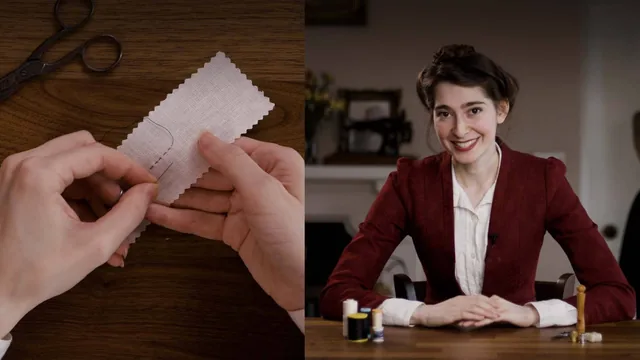
A dress historian teaches five essential hand stitches with real garment examples, delivering genuine sewing competence in just over an hour.
A historian's case for the needle
Bernadette Banner opens by reframing hand sewing as durable craft rather than a fallback for what a machine cannot do, and that reframing shapes the entire class. Because her frame of reference is period construction rather than modern machine sewing, she treats hand stitching as a primary skill with its own logic, not an afterthought. The tools segment reflects that mindset: rather than a generic supply list, she explains why a Number 10 sharp needle gives finer stitches, why linen thread needs beeswax to stop its barbed fibers from fraying, and why a soft leather thimble suits beginners better than a hard sized one. This is more grounding than most beginner classes bother with, and it pays off once the actual stitching starts.
The stitch progression is the spine of the course, and it is well sequenced. The running stitch comes first as the fast, low-commitment entry point, demonstrated on a petticoat's inserted lace where speed mattered more than strength. The back stitch follows as its stronger, slower counterpart, with a genuinely useful diagnostic: gently tugging a finished seam to see how much gap opens between stitches, which makes seam strength visible rather than theoretical. The combination stitch, three running stitches punctuated by one back stitch, is presented as a practical compromise for long seams like the five meters of lace insertion on a reproduction skirt, and the logic of when to reach for it lands clearly.
Where the technique gets harder
The felling stitch is where the course asks more of the learner. Banner is honest that achieving a narrow hem takes practice, and her tip of pinning work to a firm cushion to create tension while sewing is a genuinely transferable trick that a beginner would not discover on their own. She is equally candid that hours of felling can strain the hand, which is the kind of practical warning many instructional videos skip in favor of pure encouragement.
The final third moves into fastenings: sewing on shank buttons versus flat holed buttons, then the buttonhole stitch itself. The buttonhole segment is the technical high point, walking through how wrapping thread over and under the needle ties a small knot that, repeated along a cut edge, reinforces it against fraying. She also shows the same knotting technique applied to worked bars, which extends the lesson beyond buttonholes into hook-and-eye closures and thread loops, a nice bit of economy in teaching one mechanism with several applications.
The class's limitation is scope, not quality. At sixty-eight minutes it covers stitches and closures but nothing about seam allowances, fitting, or assembling a full garment from a pattern, so anyone expecting to walk away able to construct clothing will need a follow-up class. The pacing also assumes a viewer who can pause and rewind to match hand positions, since some stitch angles are described verbally more than they are isolated visually. Neither issue undermines what the course sets out to do. It promises stitch fundamentals grounded in real construction practice, and it delivers exactly that, with enough historical context to make the mechanics memorable rather than rote.
The standout
The buttonhole stitch lesson, which shows how looping thread into a knotted edge reinforces a cut slit so it survives repeated use without fraying.
What you will learn
- How to thread a needle, anchor thread with a back stitch or knot, and finish a seam invisibly between fabric layers
- The running stitch for fast, low-strain seams and the back stitch for strong, load-bearing ones
- The combination (running back) stitch that blends speed with periodic reinforcement
- The felling (whip) stitch for narrow hems and appliqué, including how to pin work to a cushion for tension
- How to sew on both shank and flat buttons securely, and how to work a hand-stitched buttonhole
Best for: Complete beginners who want to mend clothes, replace buttons, or start hand-sewing garments with historically grounded, durable technique.
Skip it if: Anyone who already sews by machine and needs pattern-drafting, fitting, or garment-construction skills rather than stitch fundamentals.