
Fun and easy watercolor backgrounds: Part 1
Ayesha Ansari · Artist
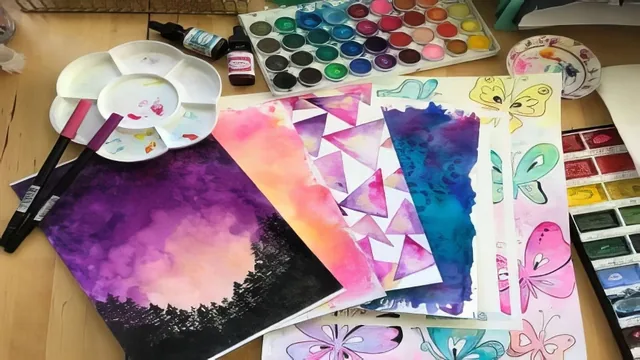
A quick, low-pressure watercolor session that teaches four backgrounds in fifty minutes, no drawing skill required.
What it actually teaches
"Fun and easy watercolor backgrounds: Part 1" is a fifty-minute primer built around four standalone background techniques, followed by a two-part project that combines them. The geometric lesson has students loosely sketch triangles in pencil, erase the lines until they're barely visible, then flood the shapes with color and let the pigment bleed across wet edges. The night sky lesson is the most developed segment: a wet-on-wet gradient from peach through pink into purple and black, dabbed on in two drying passes to deepen the color, followed by a silhouette tree line built up in successive layers of gray-to-black and finished with flicked white ink for stars. The splash lesson uses a plastic sandwich bag technique, smearing color onto a cling-film-like sheet, pressing wet paper into it, and peeling it back to reveal a mottled, marbled texture, later refined with a stencil and sponge for added pattern. The final project asks students to mask a border with washi tape, paint blended butterfly shapes inside it using analogous color pairings, then outline everything in pen once the tape is removed.
Where it succeeds
The pacing suits its stated audience. Nothing here requires drawing ability, color mixing precision, or expensive supplies, and the teacher repeatedly emphasizes that any brand of watercolor pan, tube, or liquid ink will work. That flexibility is a real strength for someone who wants to start painting immediately with whatever is already in a craft drawer. The one moment of genuine instructional substance is the aside on complementary versus analogous colors during the butterfly project, where the reasoning behind color choices actually gets explained rather than just demonstrated. The night sky technique, in particular, is specific enough (dab, dry, dab again with less water, then layer the trees dark-to-light-to-dark) that a student could follow it step by step and get a similar result.
Where it falls short
Beyond that one color theory aside, the course rarely explains why a technique works, only that it does. Water-to-pigment ratios, brush pressure, and the physics of blending are gestured at rather than taught, so a student who hits a muddy or overly diluted result has little troubleshooting guidance to fall back on. The narration is also rough throughout, with frequent stumbles, mispronunciations, and run-on phrasing that make some passages hard to follow, and there is no supplementary text, diagram, or written supply list to compensate. Because the class leans on watching color spread rather than on repeatable measurements or ratios, results will vary significantly by paper and pigment, and the course offers no way to diagnose why. It is best treated as a demonstration to imitate loosely rather than a technical tutorial to master, which is fine for a casual "Part 1" but limits its value for anyone hoping to build durable watercolor skill from it.
The standout
The night sky lesson, with its two-layer dabbing technique and silhouette tree line, is the single most reusable and visually striking method in the course.
What you will learn
- How to paint a blended geometric background using loosely sketched, lightly erased shapes
- How to build a layered night sky with dabbed gradients, silhouette trees, and flicked stars
- How to create a plastic-wrap (cling film) splash background using brush pens and liquid watercolors
- How to add stencil and sponge texture on top of a finished background
- Basic watercolor material choices across pan, tube, and liquid formats and why 140lb paper matters
- How to combine two backgrounds and ink outlining into a finished butterfly-frame project
Best for: Total beginners who want fast, forgiving watercolor wins for cards, lettering backdrops, or journal pages without any drawing prerequisite.
Skip it if: Anyone wanting structured color theory, precise technique breakdowns, or polished narration and production quality.