
From Clueless to Content Creator: Make Engaging Videos That Attract An Audience
Aaron Palabyab · Filmmaker and Photographer
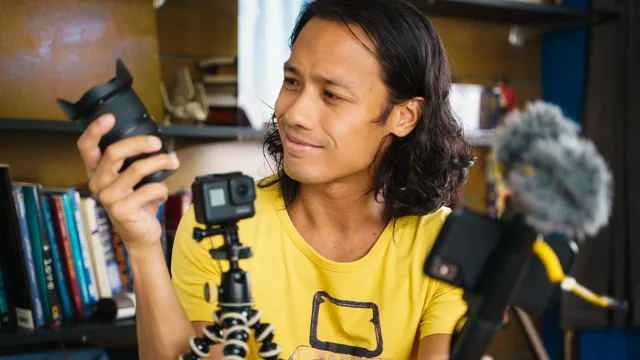
A working filmmaker gives away his actual value-over-gear framework in 50 minutes, though the on-camera and editing sections stay high-level.
Aaron Palabyab's course opens with an unusual bet for a beginner filmmaking class: it spends its first third almost entirely on strategy, not technique. Before touching a camera setting, the course walks through what it calls the one thing all content needs (value), then a three-category framework for identifying that value (information, entertainment, inspiration), then a full lesson on point of view as the differentiator once everyone in a niche is already delivering value. That ordering is the course's real thesis. Palabyab argues, using the split example of two very different coffee YouTubers, one shooting on a cinema camera with a soothing voiceover, the other filming quick clips on a phone, that audiences aren't rewarding production value so much as personality and perspective. It's a genuinely useful reframe for anyone stuck buying gear instead of making videos.
Where the course delivers
The pre-production lesson is the most immediately actionable part of the course. Palabyab describes his own two-column audio/visual script format and a shot-list habit he treats as a written storyboard, both aimed at reducing wasted shooting time and painful editing sessions. The script-structure lesson that follows breaks a video into tease, deliver, and payoff, with specific variations for tutorials, reviews, travel vlogs, and comedy, which gives the beginner something to apply immediately rather than an abstract principle. The shooting lesson gets concrete too: a recommended 50-85mm equivalent focal length for flattering talking-head shots, 24 or 30fps for people versus 60fps for B-roll that can be slowed down later, Rembrandt lighting at roughly 45 degrees, and audio levels between minus 12 and minus 6 during a sound check. These are specific enough to actually use on a shoot, not just gestured at.
Where it thins out
The lessons on being on camera and on editing are the weakest link. Being great on camera is addressed mostly through encouragement (practice, use voiceover to cover imperfect takes, don't chase perfection) rather than technique, and the editing lesson leans on general advice like learning keyboard shortcuts and organizing footage rather than any specific cutting method. Anyone hoping for a walkthrough of an actual edit or a demonstration of pacing decisions will come away wanting more. The closing lessons on distribution and long-term success, covering thumbnails, keyword research through a tool like TubeBuddy, and a nod to Kevin Kelly's 1,000 True Fans idea, are sound but familiar territory for anyone who has read much about creator economics already.
The class project, making a two-to-eight-minute video from one of six prompts, mirrors the course's own priorities well: it forces a value proposition and a point of view before it asks for technical polish. That's consistent with the course's real strength, which is mindset and positioning rather than hands-on craft. Beginners who already own a camera and know roughly how to use it, but have no idea what to actually make, are the clear audience here. Those looking to sharpen specific shooting or editing skills will need a second, more technical course to fill in what this one only outlines.
The standout
The gear-investment framework, illustrated by contrasting James Hoffmann's cinema-camera coffee channel with Dan McLaughlin's phone-shot TikTok coffee content, makes a concrete case that production value is optional and niche-dependent.
What you will learn
- How to define a video's unique value proposition using the information/entertainment/inspiration framework
- How to articulate a personal point of view as a differentiator distinct from raw information
- A practical two-column AV script and shot-list workflow for pre-production
- A three-part script structure (tease, deliver, satisfying close) tailored to different content types
- Specific shooting fundamentals: 24-30fps for talking heads, 60fps for B-roll, 50-85mm equivalent focal length, Rembrandt lighting
- How to think about gear spending as a function of niche rather than budget maximalism
Best for: Beginner creators who have gear and basic technical know-how but no clear sense of why their content should exist or who it's for.
Skip it if: Anyone who already has a defined niche and audience and needs hands-on editing or camera-operation instruction rather than positioning theory.