
Form & Space / 3D Drawing & Perspective
Brent Eviston · Master Artist & Instructor
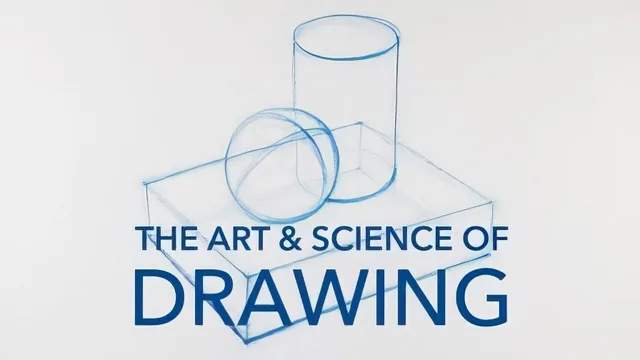
A structured, project-based method for turning flat circles and squares into believable volumetric spheres, cylinders and boxes in perspective.
A construction system, not a style tutorial
Form & Space is the third entry in Brent Eviston's Art & Science of Drawing series, and it commits to one job: teaching students to stop drawing flat outlines and start drawing volumes. The opening lessons break every three-dimensional object down to a sphere, a cylinder or a cube, then walk through the specific mechanics of each. The sphere lesson is the clearest example of the course's method: draw a circle, bisect it with two perpendicular axis lines, add an ellipse on each axis, then darken one side of each ellipse to suggest which way the sphere is turning. It is a small, mechanical recipe, and that is exactly the point. Eviston repeats the same pattern for the cylinder and the cube, so by the midpoint of the course a student has three interchangeable building blocks rather than three unrelated party tricks.
The second half is where the course earns its title. Once the primitives are established, lessons on compound and organic forms show how to combine a tapering cylinder with a truncated sphere to build something like a vase or a pitcher, and the "Beyond the Box" lesson introduces dividing a box's faces into quarters with diagonal lines so that any slice or cut made afterward stays correct in perspective. That single technique, quartering a plane before modifying it, is used repeatedly to carve boxes into new shapes and is a genuinely transferable skill rather than a one-off demo. The rims-and-handles lesson extends the same logic to vessel forms, treating a handle as a small box constructed at an angle rather than a freehand squiggle.
Where the course is strong, and where it thins out
The course's biggest strength is its insistence on why volumetric thinking matters, not just how to do it. A section on canonical perspective, referencing a 1981 study on how people default to drawing a coffee cup from a stock angle regardless of what is actually in front of them, gives the technique a psychological justification most drawing courses skip. It reframes the whole exercise: students are not memorizing shapes, they are overriding a cognitive shortcut.
Where it thins out is coverage of anything beyond construction lines. Shading, contour refinement, and rendered finish are explicitly pushed to later courses in the series, so the still-life projects here stay in a scaffolded, see-through state rather than becoming finished drawings. That is a reasonable scope decision for a 165-minute, 12-lesson course, but it means the practice results look more like blueprints than pictures, which some students may find unsatisfying even when they understand the point. The pacing also assumes daily practice sessions of 50 to 100 repetitions per shape; students who cannot commit to that volume of drilling will move through the material faster but retain less of it.
As a foundation for perspective drawing, the course is thorough and logically sequenced, with each lesson depending directly on the one before it. It rewards patience and repetition far more than passive viewing, and its value is proportional to how much of the recommended practice actually gets done.
The standout
The lesson on slicing a perspective box into new volumes by first quartering each visible plane with diagonal center-lines, since it turns an intimidating freehand problem into a repeatable, checkable procedure.
What you will learn
- Constructing a volumetric sphere from a circle plus perpendicular axis lines and two offset ellipses with varied line weight
- Drawing cylinders and boxes in any orientation using eye-level and vanishing-point logic, including tumbling boxes below and above eye level
- Dividing a box's planes into quarters via diagonal center-finding, then slicing and modifying it into new perspective-correct forms
- Combining spheres and cylinders into compound forms such as tapered necks, truncated cones and partial spheres
- Setting up a proper drawing station (drawing board angle, easel or drawing horse) so the line of sight stays perpendicular to the page
- Comparing width-to-height proportions on an observed object before committing marks to paper
Best for: A beginner who has already built basic mark-making control and wants a concrete, repeatable system for making objects look three-dimensional rather than flat.
Skip it if: Anyone who wants shading, rendering or figure drawing in this course, or someone unwilling to do daily 50-to-100-repetition drawing drills.