
Flower Painting & Pattern + Abstract Art & Japanese Inspiration
Karina Eibatova · Use a pencil as a magic wand
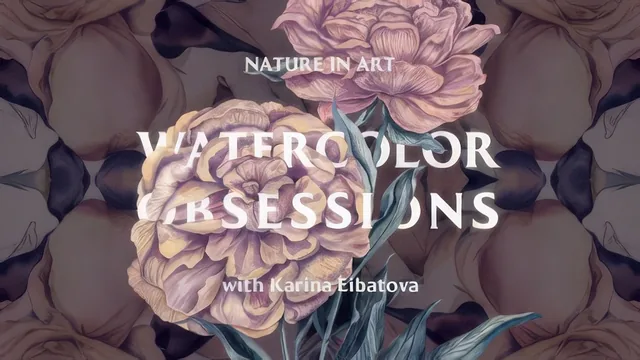
Three tidy demos and one Photoshop pattern trick, in 43 minutes, for painters who already know their way around a wash.
Karina Eibatova's class is less a single tutorial than a sampler plate: seven short lessons that move from traditional watercolor into Nihonga-inspired mineral pigments, then into a Photoshop pattern exercise, then into loose abstract painting. At 43 minutes total, nothing gets more than a few minutes of screen time, so the course works best as a tour of ideas rather than a slow, hand-held skill build.
What actually gets taught
The backbone technique is the wet-into-wet gradient wash, introduced in the peony lesson and reused throughout the class. Water goes down first, color is dropped into it top, middle, and bottom, and the paper is left to dry before any object is painted on top. From there the peonies are built petal by petal, letting colors bloom into each other and adding darker details only once each section is dry. It is a legitimate and useful sequence, but it is described more than demonstrated in granular detail, so someone without prior wash experience will likely need outside reference to actually replicate the timing.
The Nihonga material introduction is the class's most distinctive content. Gofun, mineral pigments ground from malachite and azurite, glue-bound paints, and brushes mixing weasel, goat, and wolf hair all get named and briefly explained. It is genuinely interesting context, and the stone paintings later in the course show what those grainy, glossy mineral pigments look like on paper compared to standard watercolor. But this section stays informational rather than instructional. There is no walkthrough of how to prepare the glue-pigment mixture or handle the materials hands-on, so it reads more as an inspiring aside than a technique a viewer could reproduce afterward.
The pattern design detour
The Photoshop lesson is the sharpest, most practical stretch of the course. It walks through cutting a painted flower out of its background with the Pen tool, correcting color with Selective Color and Hue/Saturation, then building a mirrored, tileable pattern by copying and flipping layers into quadrants before using the Offset filter to make the seams invisible. This is a concrete, transferable workflow that has nothing to do with painting skill and everything to do with digital production, and it stands apart as the one segment with a clear before-and-after outcome: a flower painting becomes a wallpaper-ready repeat.
The closing lessons on stones and abstract flow paintings return to the brush. The stone series shows a nice arc, from a literal circle of stones rendered in Gansai watercolors, through a more abstracted version of the same subject, finished with brush-marker outlines and dot detailing. The final abstract lesson is the loosest of all: paint applied fast, without planning, followed by marker linework and a Kanji character added purely for visual effect, which feels more decorative than meaningfully connected to the technique being taught.
Taken as a whole, the course delivers exactly what its title promises, a set of loosely related demos rather than a structured skill progression. Viewers get exposure to Japanese materials, a repeatable pattern-making workflow, and several painting demonstrations, but pacing is fast and explanations are compressed, so anyone shaky on basic watercolor control will find gaps between what is shown and what is explained. It rewards viewers who already paint and want new references and one solid Photoshop trick, more than those looking to build technique from the ground up.
The standout
The Photoshop segment on building a seamless mirrored flower pattern with layer flips and the Offset filter is the one skill here with a clear, repeatable payoff beyond the paper.
What you will learn
- Painting a wet-into-wet gradient background and building a peony still life with the bloom technique
- Mixing and layering Gansai and mineral-based watercolors to get grainy, glossy texture
- Turning a scanned flower painting into a mirrored, tileable Photoshop pattern using Offset and layer flips
- A fast dry-on-wet method for loose floral sketches in a heavyweight sketchbook
- Painting stones from life with light-to-dark layering, then finishing with brush markers and pen dots
- Making quick abstract watercolor pieces by working wet-on-wet without pre-planning the composition
Best for: Watercolorists who already have basic wash and color-mixing skills and want fresh material references, mineral pigment exposure, and a pattern-design shortcut.
Skip it if: Total beginners needing step-by-step brush handling or paper prep, since the class assumes those basics and moves through techniques quickly without dwelling on fundamentals.