
Find Your Style with Character Portrait Illustration: Drawing Faces Inspired by Astrology
Iva Mikles · Illustrator | Top Teacher | Art Side of Life
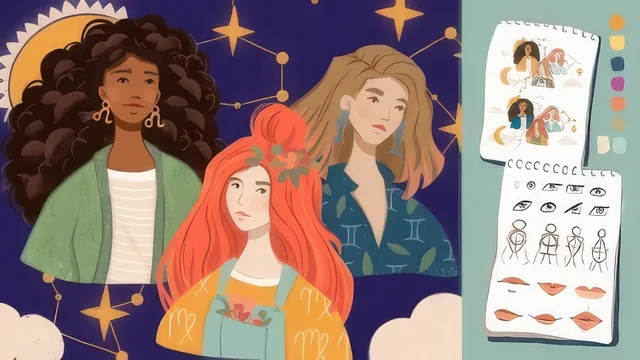
A calm, technique-dense walkthrough of stylized face drawing that trades realism for a repeatable, personality-driven shape system.
Iva Mikles' class sets out to answer a narrow but genuinely useful question: how do you go from "I can copy a face from a photo" to "I have a repeatable system for designing faces in my own style"? The answer, spread across twenty lessons and roughly two hours, is a shape-first method applied consistently to every part of the face, then wrapped in a zodiac-themed project to keep the practice from feeling like dry drills.
Structure and teaching method
The course front-loads fundamentals before letting anyone touch color. Proportions come first, using horizontal guideline divisions to place eyes, nose, and chin, with an explicit callout for how kid or younger characters shift those ratios (bigger eyes, closer-together features, larger head-to-body scale). From there it moves into head angles, showing how a curved midline and eye-line, rather than a full redraw, convey a character looking up or down. This is a smart teaching choice: instead of treating each pose as a separate lesson, it teaches one adjustable system and lets students apply it repeatedly.
The middle stretch, covering eyes, eyebrows, noses, and mouths, is where the course earns its keep. Each feature gets broken into primitive shapes: an eye can be a plain circle, an oval with a curved eyelid line, or a parallelogram, each paired with variations in eyelash treatment, pupil size, and color choice. The eyebrow lesson goes further than most character-design classes bother to, suggesting small humanizing details like a gap suggesting a piercing scar or loose hairs at the brow's start. These are the kind of specific, transferable choices that actually shape a personal style, rather than generic "make it your own" advice.
The project and its limits
The zodiac framing is a clever motivational device more than a technical one. Students pick a sign, research its associated colors and personality traits, and use that research to drive concrete decisions, gold and orange for a Leo, green and brown for a Virgo, dual-tone hair for Gemini's twin symbolism. It gives beginners a decision-making shortcut when faced with the blank-page problem of "what should this character look like," and the later lessons on composition, triangular character placement, and constellation motifs extend that idea into a full illustrated piece with three characters.
Where the course is thinner is on color theory and rendering technique. The lessons on base colors and shading lean heavily on procedural narration, showing which layer gets which texture brush, rather than explaining why a given shadow color or saturation choice works. A tip about pushing shadow colors toward more saturated tones instead of gray is useful, but it arrives as an isolated tip rather than part of a broader color framework. Students hoping for a deep dive into lighting or rendering will need to look elsewhere.
The Procreate-specific brush and streamline guidance is helpful but perishable, tied to interface details that shift with app updates. None of this undercuts the core value: a working, well-demonstrated shape vocabulary for faces that a beginner can absorb in one sitting and reuse indefinitely.
The standout
The eye and eyebrow simplification lesson, which breaks a realistic eye down into interchangeable primitive shapes (circle, teardrop, parallelogram) and shows how swapping just eyelid line, pupil size, and eyebrow thickness produces distinct character personalities.
What you will learn
- How to block out head and face proportions using horizontal guideline divisions for frontal and three-quarter views
- How to adjust head angles (looking up, looking down) by curving the eye-line and midline instead of redrawing from scratch
- A library of simplified shape options for eyes, eyebrows, noses, and mouths that can be mixed and matched into a personal style
- How to simplify hair into silhouette-first shapes, hairlines, and parting styles rather than drawing strand by strand
- How to build a full character illustration from rough sketch to refined line art to flat color to textured shading
- How to use zodiac sign research (colors, symbolism, personality traits) as a structured way to make design decisions
Best for: Beginner to intermediate digital illustrators who already move around Procreate comfortably and want a structured way to design consistent, personality-rich stylized faces instead of copying references.
Skip it if: Anyone hoping to learn anatomically accurate portraiture, painterly rendering, or Procreate fundamentals from scratch, since the class assumes basic app familiarity and stays firmly in simplified, cartoon-adjacent territory.