
Find Your Style: Five Exercises to Unlock Your Creative Identity
Andy J. Pizza · Illustrator, Designer & Podcaster
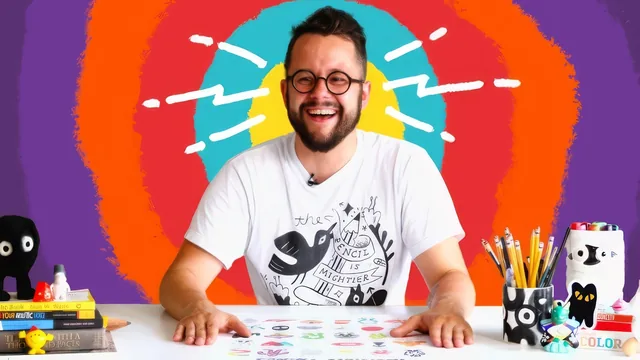
Andy J. Pizza turns a vague creative-identity quest into five hands-on exercises, but the payoff depends entirely on how much boarding and journaling you're willing to do.
Andy J. Pizza opens with a grudge: an art professor once told him style isn't found, it finds you, a line he spent years resenting before building an entire framework to prove it wrong. That grudge becomes the spine of this class. Style, in his telling, is not a lightning-bolt discovery but the sum of four building blocks: identity (the fixed facts of who you are), taste (what actually moves you, not just what looks impressive), experiments (the accidents buried in your old work), and experiences (the memories that inform what you make). The class asks you to excavate each one deliberately rather than wait for inspiration.
Structure and the boarding exercises
The first two exercises are the backbone. Exercise One has you build four separate mood boards, one per building block, pulling in everything from childhood influences to happy accidents in past projects. Exercise Two turns that raw material into analysis: you go back through every image and write down why it's there, hunting for repeated patterns until a "master board" of core values emerges. Pizza walks through his own boards as a worked example, showing how patterns like flat color, hidden or invisible imagery, and a cast of diverse characters kept resurfacing across boards he'd built independently. This is the strongest stretch of the course because it's concrete: you can see exactly how a scattered pile of references collapses into a short list of guiding principles.
The middle exercises get more playful and slightly less rigorous. "You on a Plate" borrows a Gordon Ramsay phrase to justify smashing contradictory influences together on purpose, using a set of downloadable prompt dice (a childhood tattoo idea, a guilty pleasure, a family memory) to force unlikely combinations onto the page. "Populate Your World" is the most useful of the five, built around a real case study of a black-and-white mural project where two illustrators worked out their combined style by isolating single objects, deciding rules like "always end a line with a flat edge or a perfect circle," and only later assembling a full scene from those small, already-solved decisions. It's a genuinely transferable idea for anyone who freezes up trying to make one masterpiece capture their whole style at once.
Where it thins out
The final exercise, building an actual style key or style guide, is where the class gets vaguest. Pizza shows off his own viral style-key illustration but gives comparatively little instruction on how to construct one from scratch beyond "compile your favorite pieces." Writers or musicians are told to make an analogous compilation but given no real medium-specific guidance, which makes the "any creative, any medium" pitch feel thinner than advertised for anyone who isn't drawing.
The three "Cosmic Minute" interludes (aliens, superhero metaphors, consciousness-as-emergence) are engaging but pad the runtime without adding new instruction, and a chunk of the middle section leans on Pizza's personal work history more than transferable technique. The exercises themselves are sound and would genuinely produce a usable artifact if followed seriously, but the class rewards people who already have a backlog of past work and are willing to spend real hours boarding and journaling, not people looking for a shortcut. Anyone expecting quick visual formulas will find long stretches of philosophy between the actionable parts.
The standout
The 'populate your world' method of isolating small recurring choices (like always drawing shoes the same way or shading only with tiny circles) into fixed personal rules, rather than trying to nail an entire style in one big piece.
What you will learn
- How to break your creative identity into four building blocks (identity, taste, experiments, experiences) and build a Pinterest board for each
- How to mine your own past work and Pinterest boards for recurring patterns and turn them into a written list of core values
- How to force deliberate mashups of contradictory influences using the 'You on a Plate' dice tool to create combinatorial work
- How to isolate and standardize small recurring elements (a shoe, a line weight, a way of shading) into personal drawing rules, so a whole world of work feels consistent
- How to compile finished pieces and rules into one reference style guide or 'style key' you can return to on every project
Best for: Working illustrators, designers, or other visual creatives who already make things regularly and want a structured way to name and systematize choices they're making unconsciously.
Skip it if: Total beginners with no body of past work to mine, or anyone wanting quick visual tricks rather than a multi-session identity and journaling exercise.