
Find Your Creative Style: An Exploration Through Floral Techniques
Peggy Dean · Top Teacher | The Pigeon Letters
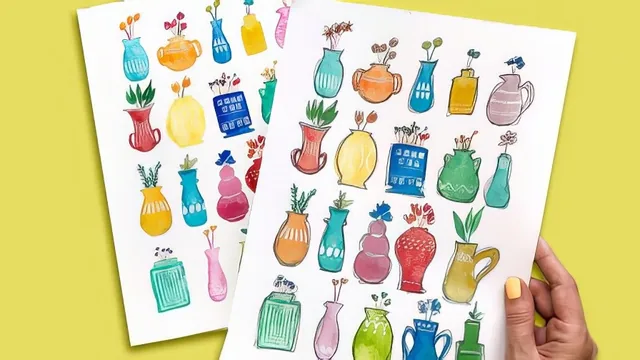
A drawing-loose, color-play warmup that expands your visual vocabulary but never resolves into a finished, framed piece.
A style sampler, not a finished piece
Peggy Dean frames this class around a simple premise: style is not a fixed identity you're born with but something you build by trying techniques you wouldn't normally reach for. The course structures that idea into two loose halves, a painting section on color and shape, then a drawing section on line and form, closing with a short chapter on marrying color with detail work. There is no single final project. Instead, each lesson is a standalone drill meant to fill a page with variations.
Part 1 opens with vases, chosen because their shapes are simple enough to riff on quickly. Dean paints a dozen or so in different silhouettes and colors, then layers flowers on top using stems in unexpected hues like hot pink and turquoise instead of green. The point lands well: putting pink next to pink, or letting cool and warm colors bleed unpredictably, produces combinations a more cautious painter would never risk. She follows with a pattern and detail pass using an opaque white pen and gel pen, then an ink outline pass where she deliberately misaligns the black line from the painted shape underneath. That imperfect-outline lesson is the strongest idea in the painting half, since it demonstrates concretely how loose, offset ink can make a piece feel intentional rather than sloppy.
From doodles to realism
Part 2 shifts to line drawing and opens with a genuinely useful, underappreciated point: pen nib size (01, 05, 08) changes not just line weight but the emotional register of a finished piece, thin lines read as delicate, thick ones as bold and unfussy. From there the course moves through forward-facing doodle flowers, built from a center and radiating petals, then side-facing doodle flowers and simplified rose shapes. These pages move fast and are meant to be quantity over precision.
The most technically rewarding stretch is the realistic flower lesson, where Dean draws a peony petal by petal, showing how uneven bends at the base and small dips at a petal's tip create the illusion of movement and folding without any shading. It is a specific, teachable trick that a beginner could apply well beyond flowers. The leaf lesson that follows is brief but effective, showing how shifting the width between a leaf's spine and its outer edge alone can make it read as tropical, coniferous, or weedlike.
Where it comes up short
The course's honesty about its own looseness is both a strength and a limitation. Because nearly every lesson is an unplanned, page-filling exercise, there is little sense of building toward a resolved outcome, and viewers hoping for a completed illustration to hang on a wall will be disappointed. The final chapter on adding color and detail is the most conceptually rich part of the class, showing how the same flower can be outlined, left outline-free with only internal marks, or rendered almost entirely through negative space, but it arrives late and moves through its options quickly rather than letting any one sink in.
At 85 minutes across twelve lessons, this plays more like a set of warmup drills than a comprehensive style course. It succeeds at what it promises: loosening habitual choices and expanding a beginner's sense of what floral illustration can look like. It does not succeed as a guide to developing a signature style, since that synthesis is left entirely to the viewer's own follow-up practice.
The standout
The realistic petal-folding demonstration in Part 2 Lesson 4, where a single dipped line at a petal's tip is shown to imply depth and movement without shading.
What you will learn
- How to generate quick painted vase silhouettes as a base for style experimentation
- Techniques for pairing unexpected stem and petal colors instead of defaulting to green and brown
- How pen tip size (01, 05, 08) changes the character and finish of a line drawing
- Multiple approaches to doodling forward-facing and side-facing flowers from a simple center-and-petal formula
- How to add realistic folds, dips, and layered petals to peonies and rose-like flowers for a more botanical look
- Different ways to place ink or white detail work over a painted piece, including offset outlines and pattern fills
Best for: Beginner to intermediate florals-focused artists who already have basic brush and pen control and want structured prompts to loosen up and try unfamiliar color or line choices.
Skip it if: Anyone wanting a step-by-step guide to one finished, polished floral piece, or a true beginner who needs help holding a brush or mixing paint before experimenting with style.