
Fearless Art Challenge: a 14-Day Drawing Challenge to Unlock Your Creative Self
Marie-Noëlle Wurm · Artist, illustrator, HSP
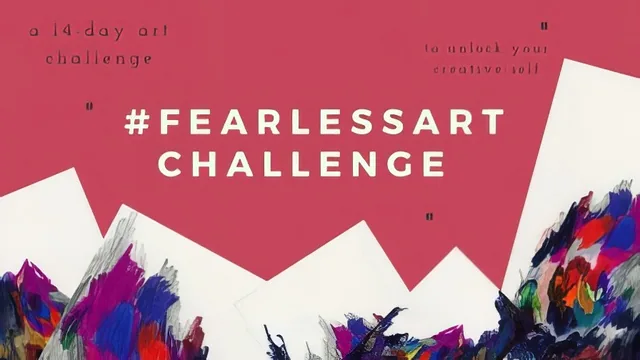
A gentle, low-tech 14-day prompt list that pushes you to draw daily, not a lesson in technique or craft.
A prompt list, not a technique class
This course is built entirely around structure, not instruction. Marie-Noëlle Wurm hands out one prompt per day for 14 days, ranging from single evocative words (journey, structure, thread, metamorphosis) to physical constraints (draw very slowly, then draw with fast, whole-body energy) to compositional rules (fill the page completely, or leave deliberate negative space, or flatten out all perspective). Each prompt gets a short setup video and a demo of her own interpretation, usually just a few minutes of drawing with light narration about what she is noticing as she goes.
The arc is genuinely well thought out even if the individual days are simple. Early prompts (journey, cloudwatching) are open-ended and forgiving. The middle stretch pairs opposites, slow versus fast, minimal space versus full page, so you feel the contrast in your own hand rather than being told about it. The back half gets more interesting: Day 11 asks you to find a drawing you dislike and physically transform it into something else, and Day 13 asks you to pull two unrelated elements from earlier drawings and merge them into something new. These two exercises are the closest the course comes to teaching an actual skill, since both give you a repeatable method for generating new work from material you already have, rather than staring at a blank page.
What the course does not do is teach drawing. There is no instruction on line quality, proportion, value, color theory, or rendering. The demos show Wurm's own tools (dry markers, brush pens, whatever is lying around) and her thought process, but she is explicit that her interpretation is not the point and that the viewer should ignore it in favor of their own. That is a defensible creative philosophy, but it means a true beginner gets almost no scaffolding. Someone who does not already know how to hold a pencil with intention or think in shapes will find the 14 days more disorienting than clarifying.
Where it earns its keep
The real value is behavioral, not technical: a low-friction habit-builder that removes the "what do I draw today" excuse for two weeks straight. The prompts are varied enough to prevent boredom, and the emphasis on mistakes as data rather than failure is consistent and reinforced through interludes, including a reading of an Austin Kleon passage on amateurism and a closing quote from David Lynch on creativity. These asides are brief but add a little textured motivation between the mechanical prompt-and-demo rhythm.
At 105 minutes across 35 short lessons, the course is fast to consume but slow to actually complete, since the real work happens off-camera over two weeks of daily practice. That mismatch is fine for its purpose. It is a companion and a nudge, not a curriculum, and anyone expecting to come out with new technical ability will be disappointed. Anyone expecting a reason to open their sketchbook every day for two weeks will get exactly that.
The standout
The Day 11 'transform me' exercise, where you deliberately rework a drawing you dislike instead of abandoning it, is the one technique with lasting value beyond the challenge itself.
What you will learn
- How to generate a drawing from a single abstract word prompt (journey, structure, metamorphosis, thread) without overthinking the interpretation
- A physical-speed exercise: making one drawing with deliberately slow, present movement and another with fast, energetic, whole-body marks
- How to build compositions around a specific constraint, such as negative space versus a filled page, or a flattened, perspective-free image
- A revision technique for reworking a drawing you dislike into something new rather than discarding it
- A remix technique for combining two unrelated elements pulled from earlier drawings into one new piece
- How to turn an everyday photographed texture (bark, concrete, fabric) into the starting point for an abstract or figurative drawing
Best for: Hobbyist and intermediate artists who already have basic drawing tools and skills but need a structured nudge and daily accountability to keep sketching.
Skip it if: Complete beginners looking for instruction on how to draw, or anyone wanting technique-focused lessons on rendering, anatomy, or composition rules.