Exploring Your Illustration Style: Exercises to Push Your Work
Ryan Putnam · Designer & Illustrator
A quick, hands-on sketchbook of seven unconventional drawing exercises meant to jolt a stuck illustrator out of habitual mark-making.
Ryan Putnam's class is built on a simple premise: habitual style is a rut, and the way out is a set of physical constraints that force a hand to move differently than it's used to. The course delivers exactly that premise and not much more, which makes it a tight, useful hour for the right person and a thin one for anyone expecting depth.
The seven exercises
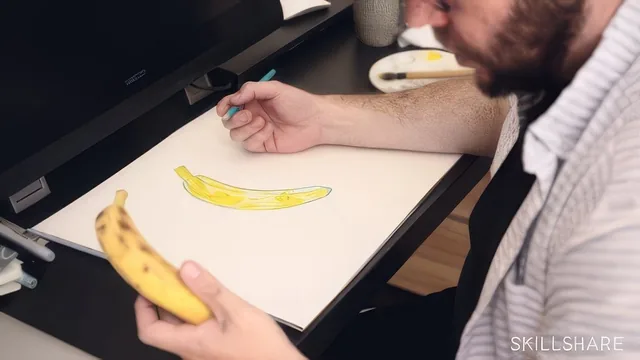
The structure is the course. After a short intro, Putnam runs through seven drawing prompts in quick succession: a continuous blind contour self-portrait done while looking only at a mirror, a yardstick drawing where a marker taped to a stick forces drawing at arm's length, a tactile drawing done eyes-closed by touch alone, a subtractive charcoal piece built by erasing tone rather than adding line, a chunky media exercise mixing acrylic blocks with colored pencil detail, a brushed media pass using a paintbrush taped to a stick, and a natural media subtractive self-portrait made by arranging twigs and dirt in front of a mirror. Each one takes a few minutes on screen and follows the same rhythm: pick an everyday object (a banana shows up twice, a self-portrait three times), apply the constraint, and narrate what came out of it. Nothing here is technically demanding. The value is entirely in the constraint itself, arm's-length drawing, eyes-closed drawing, subtraction instead of addition, and in Putnam's habit of pausing after each one to point out where his own hand defaulted to familiar shapes.
That self-critique is the most useful recurring beat in the class. After the blind contour drawing, he notices he lingered on eyes, nose, and mouth but rushed the hat, and immediately turns that into a note about what to exaggerate later in digital work. It is a small moment, but it demonstrates the actual skill the course is trying to teach: using a rough drawing as diagnostic evidence about personal style rather than as a finished product to judge.
From sketchbook to screen
The back half moves into Illustrator, where Putnam scans the charcoal subtractive self-portrait, traces it, and builds a multi-piece illustration by collaging its shapes with elements borrowed from an older marker portrait. This section is where the class earns its "polished output" promise, and it is also where it gets technically specific for the first time: creating a scatter brush from a vector path with randomized rotation and spacing, building custom art brushes from scanned line work by standardizing artwork height to one point so stroke weight scales predictably, and layering appearance-panel drop shadows via offset path effects at low multiply opacity. Anyone comfortable in Illustrator will find these small, concrete, and worth pausing to replicate.
What the course does not do is teach drawing fundamentals, color theory, or composition in any structured way. Choices are explained as instinct ("I like how this is turning out") more often than as principle, which fits Putnam's loose, in-the-moment narration style but leaves viewers who want a framework wanting more. The pacing is also uneven: physical exercises fly by in a couple of minutes each, while the Illustrator brush-building runs long relative to its teaching density, with some repeated steps.
As a jolt to break a stale process, it works. As a self-contained technique course, it is thin. Illustrators with an established practice who need a fast, low-stakes way to shake up their line work will get real mileage from an afternoon spent working through these seven prompts alongside Putnam. Anyone hoping to learn how to draw, or how to build a style from nothing, should look elsewhere first.
The standout
The subtractive charcoal exercise, laying down tone and erasing shapes rather than drawing lines, is the single most transferable idea for rethinking how light and shadow get built.
What you will learn
- How to run a continuous blind contour self-portrait to expose habitual drawing tendencies
- How to draw an everyday object (Ryan uses a banana) by taping a marker to a yardstick and drawing at arm's length
- How to draw by touch alone using a natural object, eyes closed, to generate raw texture
- How to build tone with charcoal and then subtract it with erasers and a chamois to think in negative space
- How to scan analog textures into Illustrator and turn them into custom art brushes and scatter brushes
- How to collage exercise-derived textures and shapes into one finished, colored digital illustration
Best for: Illustrators or designers with a working style who feel stale and want short, physical prompts to loosen up before returning to digital work.
Skip it if: Absolute beginners looking for step-by-step drawing fundamentals or software tutorials, since technique instruction is minimal and the pace is loose.