
Explore Your Creativity: Create a Playful, Personal Greeting Card
Carly Kuhn · Artist, Illustrator
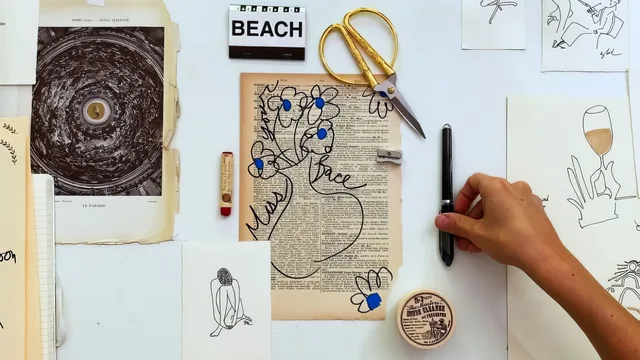
A 33-minute nudge to draw on trash you already own, not a course that teaches you to draw.
Carly Kuhn's class is less a drawing lesson than a permission slip: use what's already on your desk, make something imperfect, give it to someone who loves you. That framing is consistent from the introduction through the final thoughts, and it is the class's real subject. The greeting card is the vehicle, not the point.
What actually happens
The structure is simple and it holds. After a short pitch on "expanding your creativity," the class moves through materials (a torn page from an antique encyclopedia, a produce-box insert, a magazine ad), then into two live demonstrations: a card for Kuhn's mother built around a wine glass and the phrase "love you to the moon and back," and a card for a friend built around a vase of flowers and the phrase "miss your face." Each demo is immediately followed by a breakdown lesson that names what just happened: pick one grounded object, keep it simple, then experiment with scale and placement before committing to a text layout. That repeat-then-explain rhythm is the closest thing the class has to a teaching method, and it works reasonably well for retention.
The most concrete, transferable idea is the lettering approach: words are drawn as part of the image, following the curve of an object, changing size mid-phrase, sometimes overlapping the drawing rather than sitting beside it. Watching the same two words, "miss your face," rendered small in a corner, then large and looping around a vase, is a clearer demonstration of how typography changes mood than most of the class's other segments, which lean more on narration than on visible technique.
Where it thins out
The color and texture lesson is a single unlabeled pass with oil pastels, described mostly in terms of how it feels rather than how to choose a medium or a color. The closing styling segment, on shooting the finished card for Instagram, covers real ground (parallel angles, close-up versus wide shots, adjusting exposure and white balance in VSCO) but moves through it quickly, more as a demo to watch than a skill to practice.
Nothing here teaches actual drawing: how to render a wine glass, a flower, or a face is left entirely to the viewer's existing hand. For someone who cannot already sketch a recognizable object, the demonstrations will be inspiring to watch and hard to reproduce. The class is candid about this limitation in spirit, since Kuhn repeatedly frames "mistakes" as part of the style, but that framing works better as encouragement than as instruction.
At 33 minutes across nine lessons, the pacing is generous with mindset and thin on mechanics. It succeeds as a creative-permission exercise and a mild sketch of a personal, found-object aesthetic, but it should not be mistaken for a technique course. Anyone who wants to come away with new drawing or lettering skills will need to bring most of those skills in with them.
The standout
The lesson on treating hand-lettering as part of the drawing itself, letting words bend, curve, or scale with the image rather than sitting apart from it, is the one idea worth carrying into any future sketch.
What you will learn
- Sourcing found-object 'canvases' from junk drawers, old books, and product packaging instead of buying art paper
- Building a simple card composition around one symbolic object plus a short handwritten phrase
- Varying scale, placement, and lettering style (print vs. script) to change the feel of the same drawing
- Layering accent color and texture on top of a finished line drawing using mixed media like oil pastels
- Styling and photographing the finished piece for Instagram, including framing, natural light, and basic VSCO edits (exposure, white balance, grain)
Best for: Someone who already doodles or journals and wants a loose, low-pressure prompt to turn scrap paper into a one-off gift.
Skip it if: Anyone wanting actual drawing instruction, technique fundamentals, or a repeatable step-by-step system rather than a single artist's freeform demo.