
Everyday Flowers: Simple, Stunning Arrangements for Any Occasion
Spencer Falls · The Unlikely Florist
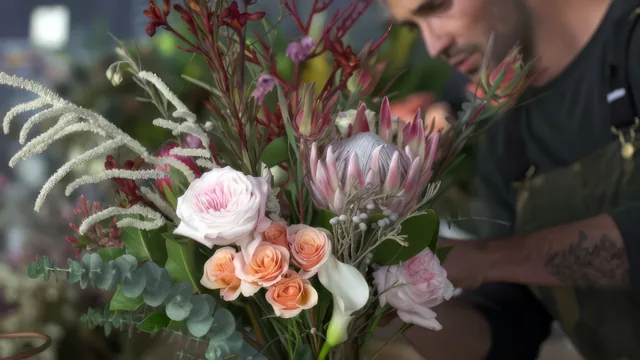
A calming, well-shot hour that teaches real florist instincts but skips past the actual how-to for beginners.
What it actually covers
Spencer Falls structures this short class as a loose progression: a flower market run, a foraging drive through Venice Beach medians, then hands-on segments building a hand-tied bouquet, a vased arrangement, and finally a dried, wall-mounted piece. Each stage builds on the last stem-prep habits learned while readying market flowers carry directly into the bouquet lesson, and the bouquet's tiered logic (leaders up top, statement blooms in the middle, denser material at the base) resurfaces almost unchanged in the vase arrangement. That throughline is the course's best structural decision. It means a viewer who watches straight through sees the same skill applied three times in three contexts, which does more to cement it than any single explanation would.
The market and foraging segments are shot as travelogue as much as instruction. There is real information in them, checking stem ends for blackening, watching for frozen or discolored leaves from imported flowers, noting that roadside medians are public property but should be cut sparingly, but it arrives as narrated observation rather than a checklist. A viewer hoping to pause and replicate the exact sourcing process will need to piece it together from a fairly conversational monologue.
Where the craft instruction lands
The bouquet-building segment is the strongest teaching stretch. Falls talks through starting with a leading stem, layering greens and statement flowers by feel as much as by eye, and correcting a stem that "doesn't want to be there" without ripping the whole composition apart. The twine-and-burlap finishing technique, tucking a tail under the thumb, wrapping to distribute pressure evenly, then wrapping the stems burrito-style in burlap, is demonstrated clearly enough to copy on a first try.
The vase arrangement lesson repeats this method with more moving pieces: crossing greenery to form a structural grid before adding statement flowers like king protea and garden roses. The advice to cut cautiously "because you can always cut more, but you can't put it back" is a useful, transferable rule. The dried-flower lesson closes the course out well, explaining which flowers hold color and shape when dried, and the trick of hanging stems upside down so gravity elongates them, information a beginner would not intuit on their own.
What it doesn't do
Because the course leans on feel and instinct ("roll with it," "don't judge the process," repeated often), it under-delivers on concrete specifics: no stem counts, no cost ranges beyond "inexpensive," no guidance on flower food, water changes, or how long an arrangement should realistically last. Viewers who want a formula to follow precisely will find themselves interpreting mood and instinct instead. The pacing also thins near the end. The dried-flower art and studio-tour segments feel more like a showcase of Falls's own work than instruction a viewer can act on.
At under an hour, this plays more like an atmospheric introduction to floristry as a creative practice than a tight skills tutorial. It succeeds at making flowers feel approachable and unintimidating, and it does contain a few genuinely reusable techniques. It just asks the viewer to extract the actionable parts from a lot of ambient, feel-your-way-through narration.
The standout
The one-part-vase-to-two-parts-arrangement ratio and the tiered leader-statement-base structure for building a vased arrangement gives an otherwise intuitive craft an actual repeatable framework.
What you will learn
- How to judge freshness at a flower market by checking stem ends and leaf color
- How to strip and clean stems so water stays free of bacteria
- How to build a hand-tied bouquet in tiers using leaders, statement flowers, and base greenery
- How to wrap and knot a bouquet with twine and burlap
- How to choose a vase shape to match the arrangement style you want
- How to select and hang flowers so they dry well and build a permanent wall piece
Best for: Total beginners who want a relaxed, inspirational first look at floristry as a mindful hobby rather than a precise skills manual.
Skip it if: Anyone wanting exact measurements, stem counts, pricing guidance, or a rigorous step-by-step they can follow without pausing and rewatching.