
Easy Doodling & Painting Fun! Create Gorgeous Botanical & Floral Illustrations in Watercolor & Ink
Yasmina Creates · Artist & Creativity Cheerleader
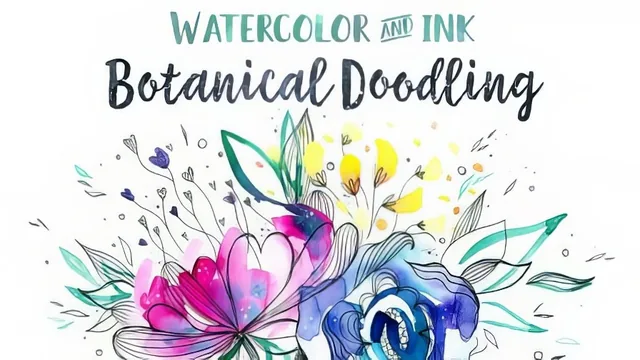
A 32-minute painless entry into loose floral watercolor and ink doodling that trades precision for permission to experiment freely.
This class promises a fast, low-pressure route into floral watercolor and ink illustration, and for the most part it delivers exactly that. In a lean nine lessons and roughly half an hour, it moves from supplies to technique to four projects of increasing complexity, ending with a bird-and-teacup piece meant to prove the method works beyond flowers. The pacing is brisk almost to a fault: there is no lesson devoted purely to drills, so technique and application are taught simultaneously, which suits confident beginners but may leave true first-timers wanting more repetition before they touch a real project.
The technical content that does exist is genuinely useful. The wet-on-wet explanation is concrete rather than abstract: three side-by-side examples show what happens with too much water, the right amount, and almost none, which gives a beginner an actual visual anchor instead of a vague "just experiment" instruction. The brush-pressure segment, showing how a size 10 round brush goes from a hairline stroke to a full petal shape by varying pressure alone, is the kind of single, repeatable skill that pays off far beyond this one class. Salt texture, splatter by tapping a loaded brush against a finger, and lifting paint with a paper towel are all shown in action rather than just described, which matters for a visual medium like this.
Where the structure earns its keep
The four projects are well-sequenced: an easy ink-first piece, a watercolor-first piece, a more complex layered composition, and a more realistic study drawn from an actual physical flower rather than a photo. Doing ink first versus watercolor first as separate projects is a smart teaching choice, since it shows two genuinely different workflows rather than one method dressed up twice. The realistic-approach lesson is the strongest pivot in the class, because it finally asks for observation from a real object and shows how a loose sketch can still anchor a more accurate result, bridging the gap between the earlier purely invented doodles and something closer to actual drawing skill.
Where it thins out
The course leans hard on reassurance ("there are no wrong answers," "don't be afraid to mess up") as a substitute for deeper instruction in several places, particularly around color theory and composition balance, both of which are gestured at but explicitly deferred to the teacher's other classes on beginners' watercolor and color mixing. That cross-referencing happens often enough that this class reads less as a self-contained unit and more as a friendly on-ramp to a larger catalog. Beginners who don't own a technical pen, decent watercolors, and hot-press paper will also need to shop before they can follow along exactly as demonstrated.
As a standalone, it does what a 32-minute beginner class should: it removes the fear of starting, teaches one or two transferable brush skills, and produces four finished pieces worth keeping. It is not a substitute for a real technique or color-theory foundation, and it does not pretend to be one.
The standout
The repeating curved-line pattern drawn inside petal and leaf shapes, demonstrated across nearly every project, gives beginners one reliable move that instantly reads as an intentional style rather than a mistake.
What you will learn
- How to control the wet-on-wet watercolor technique by varying water-to-pigment ratio for predictable spreading
- How to use pressure control on a size 10 round brush to make thin-to-thick strokes and simple petal shapes
- How to simplify real flowers into doodle shapes using only straight lines, curved lines, and circles
- How to sequence ink-first versus watercolor-first illustrations, including when to add salt, splatter, or a hairdryer-dried wash for texture
- How to build a multi-flower composition with varied sizes, patterns, and a repeating curved-line pattern inside petals for cohesion
- How to add a white gel pen for highlight detail and how to loosely sketch a realistic flower from a physical reference before inking
Best for: Complete beginners and hobby painters who want quick, forgiving wins with watercolor and pen without committing to botanical accuracy.
Skip it if: Anyone wanting precise botanical realism, structured color theory, or brush-control fundamentals from scratch, since those are referenced but pushed to the teacher's other classes.