
Drawing Toward Illustration: Connect How You Draw with How You Illustrate
Tom Froese · Illustrator and Designer
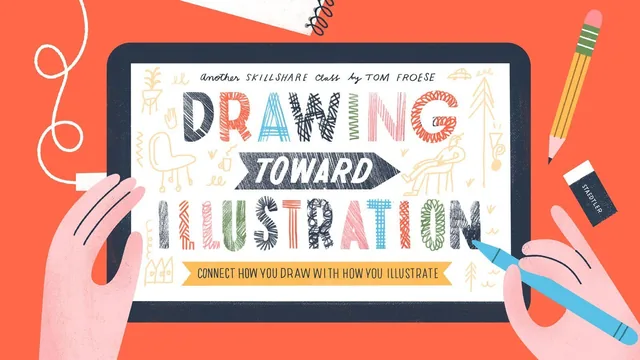
A working illustrator's two-mode drawing system, but it demands real time and offers little for beginners still learning to hold a pencil.
A process class disguised as a drawing class
Tom Froese is upfront that this is not a class about drawing better in the conventional sense. It is a class about a specific handoff problem: the gap between how someone draws when copying a reference and how they draw when inventing an illustration from nothing. His answer is a two-mode framework borrowed loosely from Betty Edwards' right-brain/left-brain drawing theory, relabeled as observational mode and ideational mode. Observational mode is where a student draws directly from a photo or object, feeding information into memory. Ideational mode is where the reference gets set aside and the student redraws the same subject from recall, deliberately allowing errors and simplifications to creep in. Froese argues those errors are not a failure of technique but the actual source of a personal illustration style.
The primer section runs long, nine separate videos before any pencil touches paper, and it front-loads a lot of theory: the 3 C's of sketching (content, composition, concept) as the only things worth discussing with a client at sketch stage, five pain points gathered from his own students, and a rundown of stylization principles like flattening and eccentrification. Some of this is genuinely useful shorthand, especially the client-conversation framing, which gives freelancers a concrete script for keeping scope creep and style debates out of the sketch-approval phase. Other parts, like the brain-hemisphere detour, function more as motivational framing than technique and could have been condensed.
The exercises are where the class earns its keep. Four subjects, a chair, a houseplant, a home workspace, and a human figure, each get the same treatment: draw from a photo using contour lines only, then draw the same subject again purely from memory. Watching a plant drawn as a tangle of blind contours, then redrawn minutes later as a stylized cluster of simplified leaf shapes, makes the observational-to-ideational shift concrete in a way the primer's lectures don't. The figure exercise is the hardest of the four and openly acknowledges its own limits, hands and feet in particular remain difficult even for an experienced illustrator, which is a more honest moment than most drawing classes allow.
The final project asks students to illustrate a full page scene of their own workspace or a dream studio, complete with a foreground figure and a detailed background. This is a substantial undertaking, moving through a loose kickoff sketch, a refined tracing pass, and then a full color, texture, and lettering pass on whatever software or medium the student prefers. The scope is ambitious for what is nominally a drawing class, closer to a full illustration production diary, and the payoff is a genuine portfolio piece rather than a one-off study.
The class assumes real prior drawing ability and offers almost nothing on mark-making fundamentals, proportion, or perspective. Anyone without a working comfort level in pencil or tablet drawing will struggle to keep up, and the instruction leans heavily on Froese narrating his own process rather than issuing exact prescriptive steps. For an intermediate illustrator stuck translating loose sketches into a consistent style, though, the memory-drawing method is a concrete, testable exercise, not just a mood board of inspiration.
The standout
The two-part exercise structure, drawing a subject from reference and then immediately redrawing it from memory, is the single technique most likely to change how a student's sketches translate into a personal illustration style.
What you will learn
- How to separate observational drawing (copying from reference) from ideational drawing (recalling and reinventing from memory)
- Contour drawing technique using confident continuous lines instead of short tentative sketching strokes
- How to run client sketch reviews around content, composition and concept while keeping style off the table
- Five stylization moves (flattening, abstraction, exaggeration, simplification) for pushing a realistic sketch toward a graphic illustration style
- How to build a multi-object scene from rough sketch through refined sketch to finished color artwork
- A repeatable two-pass exercise structure (draw from reference, then redraw from memory) for four different subjects of increasing difficulty
Best for: Illustrators and trained artists who can already draw competently but feel a disconnect between their sketches and their finished illustration style.
Skip it if: Absolute beginners looking to learn basic drawing fundamentals, or anyone wanting a fast, short tutorial rather than a multi-day process.