
Drawing Patterns: 14 Days of Mindful Drawing for Self-Care
Mel Rye · ✎ Artist + Educator
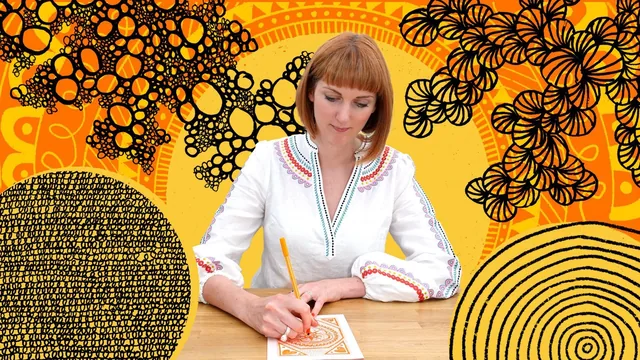
Fourteen low-pressure pattern prompts turn a blank page into a genuine daily calm practice, not an art lesson.
Mel Rye's "Drawing Patterns" sells itself as a wellness practice wearing an art class's clothes, and for the most part that framing holds up. The course spans 14 days, each built around a simple visual prompt (concentric, random fill, grid, radiate, and so on), paired with a short mindfulness exercise and a longer draw-along demonstration. The pitch is explicit from the opening lesson: this is not about becoming a better artist, it's about carving out a few minutes of calm using materials already sitting in a junk drawer.
Structure and pacing
The course opens with a genuinely useful setup phase: a materials overview, then a warm-up exercise where the viewer scans their surroundings for shapes (a mug seen from above, a scalloped shirt pattern) and records them as a personal reference library. That library becomes the seed for every prompt that follows, which gives the 14 days real continuity rather than feeling like 14 disconnected exercises. Difficulty ramps gradually: early prompts (concentric circles, random fill) require only a pen and paper, while later ones (radiate, color-based prompts) introduce stencils, colored paper, and acrylic paint. Each day follows the same two-video rhythm, a discussion video that introduces the prompt plus one related skill (finding inspiration, using a grid to structure a composition, color theory), followed by a start-to-finish draw-along. That repetition is a strength for a self-care practice, since predictability is part of what makes a ritual feel safe, though it does mean the course rewards spreading sessions across real days rather than binge-watching.
What actually gets taught
Underneath the mindfulness framing, there is real technical content. The grid lesson on mirroring and rotation is the most substantive single idea in the course: dividing a page into an even number of squares, placing an off-center design in one, then repeating it flipped or rotated, produces genuinely more interesting compositions than freehand doodling alone. The color psychology lesson is thorough almost to a fault, walking through red, blue, green, yellow, purple, orange, pink, black, and white with cultural and physiological associations for each, though it leans more into general color theory than anything specific to pattern drawing. The stencil technique introduced for the radiate prompt, cutting both the positive and negative shapes from scrap paper to use as two different tools, is a small but practical trick that extends well beyond this course.
Where the course is weaker is in its repetitiveness of format: the breathing exercise before each draw-along, the reminder to use scrap paper under the drawing hand to avoid smudging, and the closing "mindful focus for today" framing recur almost verbatim across all 14 days. For someone taking the course in one sitting, that repetition can feel padded. Taken as intended, one prompt a day, it functions more like a guided ritual script than redundant filler.
The teacher is upfront that she is not a mental health professional, and the course never oversells its therapeutic claims. It positions itself accurately: a structured, materials-light habit-builder that borrows drawing as its vehicle. For that specific goal, it delivers.
The standout
The grid-based mirroring and rotation technique in the Day 6 lesson turns a blank page into a structured, low-stakes system that alone teaches a transferable compositional skill.
What you will learn
- How to build a personal 'shape library' from everyday surroundings to draw from when uninspired
- Fourteen distinct pattern-generation methods, including concentric shapes, grids with mirroring and rotation, and stencil-based radiating designs
- How to use breathing and body-awareness exercises as a ritual bookend to a drawing session
- How color psychology (red, blue, yellow, and others) can be applied deliberately to influence mood in a drawing
- Practical shading and fill techniques such as parallel-line hatching, uniform fill, and blocking in negative space
- A repeatable framework for starting any pattern from a single simple shape, adaptable to any material
Best for: Anyone seeking a low-stakes daily creative ritual for stress relief who wants gentle structure without needing any prior drawing ability.
Skip it if: Skip it if you already have a mindfulness practice you're happy with, or if you want to build technical drawing skill rather than a self-care habit.