
Drawing Is Important: Develop a Sketchbook Habit in 30 Days
Tom Froese · Illustrator and Designer
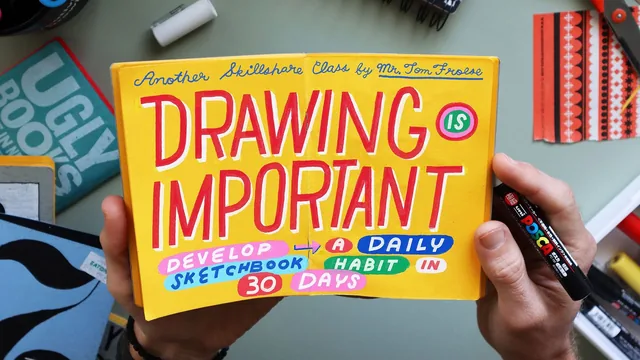
A structured 30-day habit-building plan for daily sketching, useful for motivation and consistency but teaches no actual drawing technique.
A Habit-Building Framework, Not a Drawing Course
Tom Froese is upfront about what this class is not: it is not a drawing class, and it will not teach anyone how to render a hand or shade a sphere. What it teaches instead is a system for making daily sketching sustainable, aimed at the psychological and logistical reasons people quit before day ten. Froese, an illustrator who has worked with Amazon, Yahoo and Airbnb, builds the whole class around one idea, that a plan removes the friction that kills a habit. The lessons walk through four reasons to draw daily, three common failure points, and then the five elements of a personal plan: purpose, media, schedule, subject and sharing.
The most useful stretch of the course is the diagnosis of why daily drawing habits collapse. Froese names the "inspiration gap," the moment someone sits down with a blank page and no idea what to draw, and offers a concrete fix: decide the subject matter in advance, either through a written list of 30 prompts or a single go-to reference source. His own example, an obscure 1974 Canadian mail-order catalog gifted by his sister, is the strongest teaching moment in the class, because it demonstrates that the source does not need to be inspiring in any objective sense, just consistently available and specific enough to draw from. The same logic applies to his advice on quantity-based goals: set a five-minute timer or a one-page limit rather than aiming for a drawing you'll like, since a met quantity goal builds the habit while a quality goal invites discouragement.
Where the Techniques Live
The technique content is thinner and arrives almost as an afterthought before the project steps. Froese demonstrates a handful of five-minute warm-up exercises: contour drawing of a hand or foot with a Posca paint pen instead of a pencil, to force looser and less detailed marks; and an "expressive cutouts" exercise where shapes are scissor-cut from colored paper or scrap type-specimen pages rather than drawn with a pencil first. These are genuinely good constraint-based exercises for breaking rigidity, but they are shown once each, briefly, and are clearly meant as optional inspiration rather than a curriculum.
The digital-capture segment is a practical addition many similar classes skip. Froese walks through scanning a sketchbook page at 300 dpi, cropping it square in Photoshop, and applying small contrast and saturation nudges via adjustment layers so the page reads well on Instagram without looking artificially processed. He follows it with a phone-only version of the same workflow for anyone without a scanner, covering lighting, background choice, and the trick of shooting in portrait orientation to leave crop room. It is a small but genuinely transferable skill for anyone posting sketchbook work online.
The Verdict
The project itself is exactly the three steps promised: write the plan, do 30 days of drawings, and share them. There is no drawing instruction embedded in the grading or feedback loop, no demonstration of anatomy or line quality critique, and no discussion of how to actually improve technically beyond "draw more and you will grow." That is a reasonable scope given the class's stated purpose, but it means the value here is entirely in habit design and mindset, not craft. Anyone who already has a drawing habit and wants to improve fundamentals should look elsewhere. Anyone who owns a sketchbook that has gathered dust for months will find the plan template and the pain-point diagnosis genuinely worth the 91 minutes.
The standout
The go-to inspiration source concept, using one fixed reference (Froese's own 1974 mail-order catalog) as a permanent subject bank to kill the blank-page problem every single day.
What you will learn
- How to build a personal 5-part daily drawing plan covering purpose, media, schedule, subject and sharing
- How to pick a repeatable subject source (prompt list vs a go-to inspiration object like an old catalog) to eliminate decision fatigue
- How to set quantity-based goals (time or page limits) instead of quality goals to sustain a habit
- Several quick warm-up techniques including contour drawing, blind gesture drawing and paper cutout collage
- A basic Photoshop workflow for scanning, cropping, and subtly boosting contrast and saturation on sketchbook pages
- A phone-only alternative workflow for photographing and lightly editing sketches for social media
Best for: Anyone, from total beginners to working illustrators, who wants a repeatable system for showing up to sketch daily and isn't looking for technical instruction.
Skip it if: Anyone hoping to learn actual drawing fundamentals, anatomy, perspective, or rendering skill, since the class explicitly sidesteps teaching how to draw.