
Drawing Dreams: Quick Illustrations to Find Your Passion
Elle Luna · Artist, Designer & Author
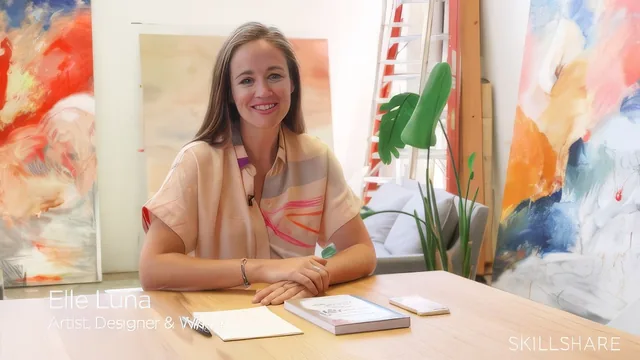
A 15-minute nudge to record and paint your dreams, built on Elle Luna's own 100-day Instagram project.
Elle Luna's class is less a drawing course than a journaling ritual with a paintbrush attached. Across six short lessons, she lays out a simple loop: record your dream by voice the instant you wake up, transcribe it later in the day, then pull one image or line from the transcript and render it on paper. The whole method can be summarized in a sentence, and Luna more or less does that herself within the first few minutes.
The strongest material sits in the sequencing of that loop. Recording before transcribing, and transcribing before drawing, is a small but genuine insight: it separates the raw, half-conscious content of a dream from the tidying-up that a fully awake mind inevitably does to it. Luna is explicit that writing immediately upon waking risks losing the dream's actual texture in favor of a version the brain has already smoothed into sense. That's a useful piece of process advice for anyone doing dream journaling, illustrated or not.
Where the class thins out is everything after that setup. "Drawing a Moment," the lesson that should be the technical core, offers almost no instruction on mark-making, composition, or color choice. Luna shows examples from her own 100-day project, paint on origami paper, a black sheet done on a plane, but describes them in terms of feeling and abstraction rather than any transferable technique. Viewers are told to "keep it simple" and "do whatever you feel called to do," which is honest encouragement but not teaching.
The materials lesson is similarly light. It amounts to: get a phone or voice recorder, get paper, get a marking tool, keep the kit small enough to fit in a bag. That's sound practical advice for building a habit that survives travel and busy mornings, but it is not going to help a beginner make decisions about brushes, paints, or paper weight.
The most memorable stretch is actually the storytelling in "Gathering Inspiration," where Luna recounts a recurring dream of a white room that she eventually found for rent on Craigslist and now uses as her studio. It's a good anecdote and it does real work in making the case that dreams carry meaningful signal, but it is personal narrative, not instruction, and it eats time that a longer class might have spent on technique.
Structure and pacing
At 15 minutes total, the class moves quickly and doesn't waste time, which suits its scope. The arc is coherent: why dreams matter, how to capture them, how to turn one into a small piece of art, and how to sustain that as a 21-day habit. Nothing feels padded, but nothing feels developed either. This plays better as a prompt to try over a few days than as something to study closely.
Who it actually serves
Taken on its own terms, as a journaling exercise dressed in creative language, the class delivers what it promises. Anyone drawn to dream interpretation, habit-building, or low-pressure daily sketching will get a usable prompt out of it. Anyone expecting to leave with new drawing or painting ability, or a rigorous framework for interpreting dream symbolism, will find the fifteen minutes thinner than the pitch suggests.
The standout
The record-first, write-second sequence, capturing the dream aloud on a phone before transcribing it, so the account stays raw instead of getting tidied up by a fully awake brain.
What you will learn
- A repeatable dream-capture routine: voice-record immediately upon waking, before checking phone or email
- How to transcribe a half-asleep recording into text without over-editing it into false coherence
- How to isolate a single image or line from a dream and turn it into one small painting or drawing
- How to build a minimal, portable art kit (one pen or paint color, small paper) that fits in a daily bag
- The idea of committing to a 21-day dream-painting practice rather than a single one-off piece
Best for: Casual creatives and journaling enthusiasts who want a low-stakes daily art prompt and don't need technical drawing or painting instruction.
Skip it if: Anyone hoping to learn actual drawing or painting technique, since the class barely touches composition, color, or rendering skill.