
Draw With Style! Stylizing Your Art & Find Your Creative Style in Drawing
Yasmina Creates · Artist & Creativity Cheerleader
A fun, encouraging 62-minute primer on stylizing references, but light on hands-on technical drawing instruction.
What the course actually covers
The course frames stylizing as a three-part loop: observe your subject by breaking it into simple shapes, exaggerate or simplify those shapes according to the style you want, then refine the drawing in whatever medium expresses that style. The teacher walks through this loop twice on camera, once with a parrot reduced to an oversized beak and rounded body, and once building a full fairy-in-a-forest scene from thumbnail sketch through gathered references to inked and watercolored final art. Watching the parrot exercise clarifies the idea better than any explanation could: keep the beak and eye markings, discard nearly everything else, and the drawing still reads as a parrot. That is the course's central, useful insight, delivered concretely rather than abstractly.
The middle stretch surveys eight illustrators (Ellie, Skye Ali, Katie Daisy, Tracy Lewis, Mat Miller, Tess Smith-Roberts, Kelsey Buzzell, Lauren Faust) and names the specific traits that make each recognizable: Skye Ali's flat, unshaded shapes with wonky perspective, Tracy Lewis's low-contrast watercolor with barely-there eyes, Lauren Faust's bean-shaped bodies and angled ears. This is the course's strongest teaching device because it trains the eye to spot what actually constitutes a style rather than treating style as an unanalyzable talent.
Where it falls short
The "finding your style" section, arguably the class's main selling point given the title, boils down to one piece of advice: study and trace many different artists (the teacher suggests ten to a hundred) without publicly sharing the copies, and a personal style will emerge naturally over time. That advice is reasonable and honestly framed as not being a shortcut with guarantees, but it is also not new information for anyone who has spent time in illustration communities, and it takes up a disproportionate amount of runtime restating the same point.
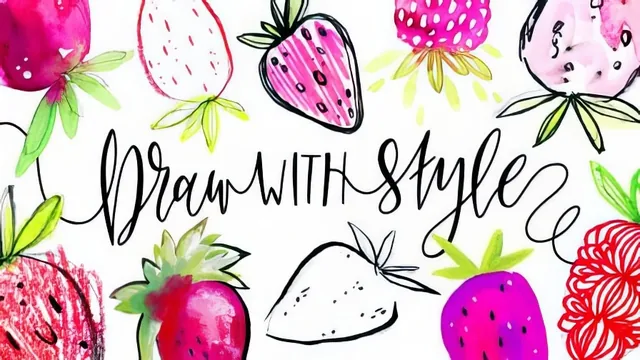
The strawberry coloring exercise is the most technically substantive segment, showing the same outline rendered in colored pencil, watercolor, gouache, marker, and ink to demonstrate how much medium choice affects final feel. It is a genuinely good exercise for a student to replicate at home. Beyond that demonstration, though, the course offers almost no direct instruction in drawing fundamentals, shape construction, or medium handling. Students who cannot already sketch a recognizable basic form from a reference will find the three-step framework difficult to apply, since the class assumes that baseline ability rather than teaching it.
Verdict
This works best as a mindset and vocabulary class rather than a skills class. It gives students a clear way to talk about and analyze style, a workable three-step process to apply deliberately, and permission to experiment without fear of "copying." It does not teach anatomy, shading technique, color theory, or any medium in depth, and the pacing leans heavily on lengthy example galleries and personal anecdotes rather than tight instruction. For a beginner who already sketches but has never thought analytically about style, it is a useful hour. For someone hoping to leave with new hand skills, it will feel thin.
The standout
The live demonstration of coloring the same strawberry sketch a dozen different ways with different mediums, showing concretely how much finishing technique alone changes perceived style.
What you will learn
- A repeatable three-step process for stylizing any reference: observe and sketch basic shapes, exaggerate or simplify with intent, then refine in a chosen medium
- How to identify the key recognizable features of a subject so simplification does not destroy readability
- A curated study of eight professional illustrators' distinct styles and what specifically makes each one recognizable
- A practical method for finding a personal style by studying and tracing many different artists without copying any single one too closely
- How medium and technique alone can drastically change the feel of the same drawn shape, demonstrated through a strawberry coloring exercise
- How to build a full illustrated scene from thumbnail sketch through multiple mashed-up references to a finished piece
Best for: Beginner to intermediate illustrators who already sketch reasonably well and want a mental framework for stylizing references and building visual confidence.
Skip it if: Complete beginners who cannot yet draw basic shapes or anatomy, or anyone wanting step-by-step technical figure drawing or rendering instruction.