
Donut Flat Lays: Tips for Better Overhead Photos
Tabitha Park · Product & Food Photographer
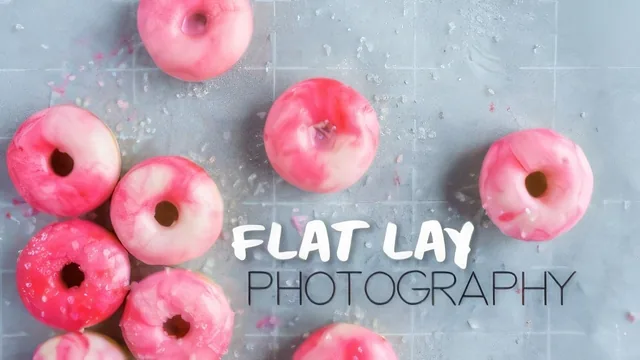
A DSLR-and-smartphone lighting breakdown built around donuts, with a genuinely useful reflector-reading trick worth the 50 minutes alone.
A lighting class disguised as a donut class
This is a course about reading and controlling light, and the donuts are mostly a pretext for practicing on something with a shiny, reflective glaze that shows exactly what the light source is doing. That framing choice pays off. Because frosting catches highlights so obviously, the instructor can point at a photo and explain, from the shape of a shadow alone, whether the light came from a window or a reflector, whether the day was overcast, and how far the camera sat from the source. It is a genuinely transferable diagnostic skill, applicable to any tabletop subject, and it is the strongest material in the class.
The middle stretch on shooting mechanics is where the course does its real teaching. The instructor is specific about staying parallel to the backdrop rather than tilting the camera, about keeping every element of a scene on the same focal plane so a taller vase does not blur out next to a flat plate, and about lens choice, favoring a 35mm or 50mm prime over a wide angle that starts pulling in your feet or a step stool. The hidden iPhone grid trick, where a white and yellow crosshair align to confirm the phone is dead level with the surface below, is a small, concrete, immediately usable tip that a lot of overhead-shot beginners never discover on their own.
Composition and editing round it out, unevenly
The composition segment leans on named principles like avoiding tangents at the frame edge and using the rule of thirds, then undercuts its own rigor by admitting the rules are meant to be broken once you have a feel for what works. That is honest advice, but it leaves the section feeling more like a checklist of terms than a system for making decisions. The editing walkthrough is more concrete, moving through a real VSCO adjustment pass, a Photoshop Express spot-heal to erase grease marks left by handling the donuts, and a full Lightroom edit that ends with a masking-slider trick to sharpen only the crunchy edges of a shot while leaving the smooth glaze untouched. Viewers without any of these four apps installed will still get the underlying logic, exposure first, then contrast, then selective sharpening, even if they cannot follow along exactly.
Where the class comes up short is depth. Camera settings are gestured at rather than taught: aperture and prime lenses come up, but there is no walkthrough of setting ISO, shutter speed, or manual mode for a beginner shooting in dim indoor light. The artificial-light segment, built around a household lamp and a sheet of wax paper as a diffuser, is a fair emergency workaround but is presented as a footnote rather than a fully developed alternative to window light. Anyone hoping for controlled studio lighting, off-camera flash, or advanced retouching will need a different course entirely.
As a beginner-level 50-minute primer, it delivers what it promises: a full arc from finding reference images on Pinterest to a finished, edited photo ready for Instagram, anchored by the shadow-reading technique that is worth revisiting on its own. It will not turn anyone into a professional food photographer, but it gives a phone-only beginner a real, repeatable process rather than a pile of disconnected tips.
The standout
The Pinterest-image lighting teardown, where the instructor reads shadow softness and direction on real reference photos to reverse-engineer whether a reflector was used, is the one skill that transfers to any subject, not just donuts.
What you will learn
- How to read a reference photo's lighting direction and softness just from its highlights and shadow edges
- How to avoid mixed lighting by working from a single window source and matching or turning off ambient room lights
- How to distinguish raking light (textured, contrasty) from diffused reflector-bounced light (soft, even) and set up each
- How to keep a flat lay parallel to the lens using the iPhone's hidden crosshair grid trick
- How to keep multiple items on one focal plane so nothing falls out of focus in a shallow-depth-of-field shot
- How to edit a flat lay through a full pass in VSCO, PS Express, Instagram, and Lightroom, including selective sharpening with the masking slider
Best for: Total beginners with a DSLR or just a phone who want a repeatable system for overhead food or product shots for Instagram.
Skip it if: Anyone already comfortable with manual exposure, off-camera lighting, or professional product photography, since the technical ceiling here is genuinely beginner level.