
Document Your Life: 4 Methods to Live More Intentionally
Nathaniel Drew · Online Content Creator
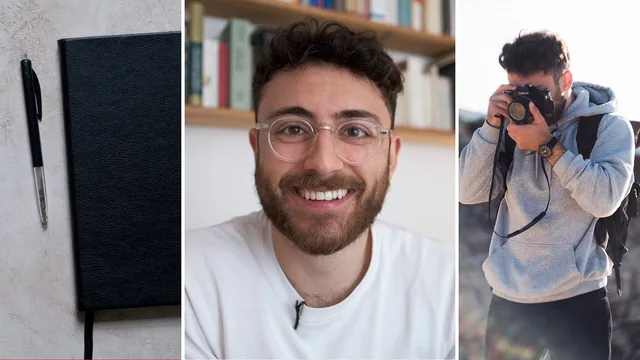
A YouTuber's philosophy on capturing daily life through four beginner-friendly methods, more mindset primer than skills tutorial.
"Document Your Life" is less a skills class than a mindset pitch delivered by Nathaniel Drew, a YouTuber whose whole career runs on the habit he's teaching. The course opens with two lessons of pure framing before it gets near a camera or a journal, and that framing (why capture matters, what makes documentation "intentional" rather than reflexive) takes up close to a third of the runtime. Viewers looking for a quick tutorial will feel the pacing; viewers who want to be talked into a habit will find it persuasive.
The four methods
Once the class moves into practice, it settles into a workable rhythm: explain the method, show the tool, give a short exercise. Vlogging is taught at the simplest possible level, phone only, no gimbal, no app beyond the stock camera, with the only real technique being to hold a shot a beat longer than feels natural and to shoot wide. Journaling gets the strongest idea in the course: instead of facing a blank page, give the journal a theme, such as writing exclusively in the language you're learning, or restricting entries to a weekly check-in on sleep and mood. That reframing of "journaling" as several narrow, purpose-built notebooks rather than one diary is the one piece of advice here that could genuinely change how someone journals.
Film photography is pitched at beginners through the point-and-shoot camera rather than a manual one, with the cost-per-frame (roughly fifty cents) offered as the reason scarcity sharpens attention. A digital substitute, capping yourself at a fixed number of shots per outing, is a fair analog if buying a camera and paying for developing isn't appealing. The fourth method, audio reporting, is the most original of the four: recording ambient sound or spoken thoughts on a phone or an old tape recorder, with the case made that audio without video actually triggers memory and imagination more than footage does. It's a genuinely underused idea for a documentation class, even if it gets the least screen time.
What holds it back
The course repeats itself. Points about keeping things simple, dating your files, and thinking long-term get restated across the principles section, the mindset section, and then again inside each method, so the same handful of ideas recur more often than the runtime justifies. The organizational advice, folders by year and month with a short label, is sound but thin, and viewers hoping for a deeper system (tagging, search, backup strategy beyond "an external hard drive") won't find one. The class also stays almost entirely in the realm of personal philosophy: there's a lot about why documentation matters to Drew personally, but comparatively little on troubleshooting the habit once it stalls, which is usually the hard part.
As a low-effort entry point into more deliberate life documentation, the class does what it sets out to do. It never asks the viewer to learn a technical skill, and it succeeds at lowering the bar to start. It's better suited to someone browsing for inspiration on a Sunday than someone who wants a structured practice built by the end of the runtime.
The standout
Assigning a specific theme to a journal, like a language-learning log or a mental-clarity check-in, replaces the blank page with a built-in prompt.
What you will learn
- How to vlog with just a phone camera, holding wide shots for several seconds instead of chasing cinematic technique
- A file-naming system for organizing footage and photos by year, month, and short description
- How to 'theme' a journal (language journal, mental-clarity journal, bullet journal) to beat blank-page paralysis
- How to shoot film photography cheaply with a point-and-shoot camera instead of a manual one
- How to use a phone's voice memo app or a cheap tape recorder to capture ambient sound like a reporter
- A short list of principles (date everything, keep it simple, think long term) for sticking with any documentation habit
Best for: Content creators, journalers, and anyone who wants a low-tech, low-pressure way to hold onto everyday memories without learning photography or video theory.
Skip it if: Anyone wanting technical camera, editing, or vlogging skills, since the teacher deliberately skips exposure, composition, and software instruction.