
Do What You Love - An Introduction To Ikigai
Tim Tamashiro · Author, Speaker, Singer
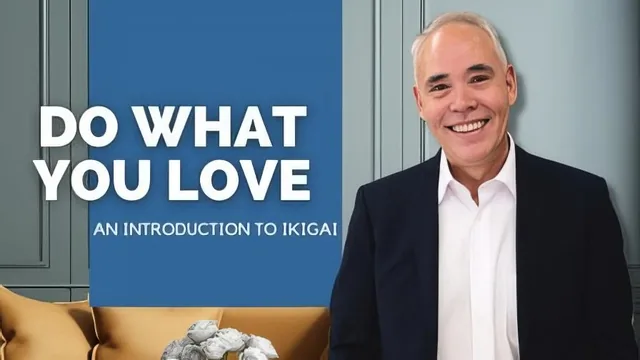
A likable storyteller turns four Japanese-inspired questions into a fast, low-rigor self-reflection exercise, not a career plan.
A Warm Introduction, Not a Full Framework
Tim Tamashiro opens with his own story, record labels, a national radio show, a flying piano, and that personal credibility carries the course. He is an easy, conversational teacher, and the origin story he tells about ikigai, tracing it to Okinawan ama divers who free-dove for a rare red oyster shell, gives the concept texture most Venn-diagram summaries skip. He is also upfront that the now-famous four-circle diagram was not ancient Japanese wisdom but a modern creation by Marc Winn, a small but honest disclosure that builds trust.
The middle stretch borrows two outside frameworks rather than building its own. Maslow's hierarchy gets used to argue that self-actualization is a daily, active need, not a luxury. Jung's four stages of adulthood, athlete, warrior, senator, spirit, get used to locate the learner somewhere on a life timeline. Both are presented as settled fact rather than one interpretation among many, and neither gets more than a few minutes, so they land as flavor and framing more than tools you'll reuse later.
Where the Exercises Actually Live
The real instructional core is narrow: two seven-minute timed writing exercises, one for what you love, one for what you're good at. That's genuinely useful because it forces output instead of passive listening, and the explore, zero in, ponder sequence gives a simple, repeatable way to sort a messy list of interests into something usable. This is also where the course's promise starts to thin out. Skillshare's blurb sells four steps, love, good at, what the world needs, and what you can be rewarded for, but only the first two get an exercise. The other two are addressed through a single extended anecdote about designers Charles and Ray Eames and a general argument that generosity increases happiness, described as ikigai being "a boomerang, not a stick." Inspiring, but there's no worksheet, no prompt, no method for figuring out what the world needs from you or how you'll get paid for it.
The closing project, naming your ikigai with a "to" plus a verb, is a nice piece of clarity but a light payoff for 65 minutes: it externalizes intention without addressing execution. The final module's three real-world profiles, an artist known for deliberately bad portraits, a doctor who is also an adventure photographer, and a couple on a multiyear honeymoon, are the strongest part of the back half, because they show ikigai working in messy, specific lives rather than staying theoretical.
Taken as a whole, this plays best as a mood-setter and a nudge toward self-reflection, not a structured method for changing your work or your career. Anyone hoping for the full four-part ikigai system, especially the market-facing half of it, will find that half of the course underdeveloped. Anyone just looking for a warm, well-told invitation to sit down and ask what they love and what they're good at will get exactly that, in under an hour and a half.
The standout
The two timed seven-minute writing exercises, one listing everything you love, one listing everything you're good at, force a concrete first pass at self-knowledge instead of leaving it abstract.
What you will learn
- The popular origin story of ikigai, tracing the word to Okinawan ama divers and a prized red oyster shell
- A working distinction between your job (paid employment) and your work (self-actualization)
- How Maslow's hierarchy of needs splits into daily deficiency needs and a daily being need for growth
- Carl Jung's four stages of adulthood (athlete, warrior, senator, spirit) as a lens for where you are in life
- A three-step process, explore, zero in, ponder, for surfacing what you love and what you're good at
- How to name your personal ikigai using a 'to plus verb' format, such as 'to delight' or 'to inspire'
Best for: Someone who has never done any structured self-reflection and wants a gentle, story-driven on-ramp to thinking about purpose.
Skip it if: Anyone wanting a practical career-change roadmap, income strategy, or rigorous treatment of positive-psychology research rather than personal anecdote.