
DIY Cinematography: Make Your Video Look Like a Movie
Ryan Booth · Filmmaker, Cinematographer, Director
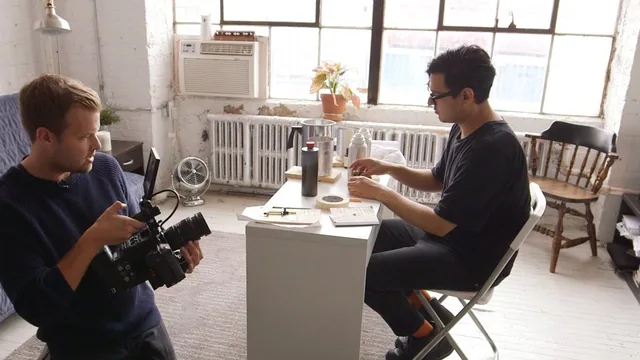
A working cinematographer shows how to shape natural window light with black fabric and a bounce card instead of buying gear.
Ryan Booth's class is built around a single constraint: walk into a room you have never shot in before and make it look expensive using only what is already there. That constraint is the whole lesson. Rather than teaching lighting setups from a kit, Booth teaches how to subtract, moving furniture out of frame, walking in black fabric to kill unwanted bounce, and treating a window as the only light source worth trusting.
The first half is vocabulary and philosophy, and it earns its place. Booth defines key light, fill, negative fill, and contrast ratio in plain terms, then admits he cannot quote an exact ratio himself and just goes by feel. That admission matters more than it sounds. It tells a beginner that professional cinematography is often a trained eye reacting to a room, not a spreadsheet of f-stops, which lowers the intimidation factor considerably.
The demonstration is the real class
Everything before the David segment is setup. Once Booth walks into the candle-maker's studio, the class becomes a live location scout: he rejects one corner because an air conditioning unit would sit in frame, drags a desk away from a window so he can shoot the subject's face rather than his back, and clears a television and boxes so the camera has room to arc around the subject freely. This is the most useful stretch of the course because it shows the reasoning behind each decision, not just the decision.
The lighting adjustments that follow are concrete and repeatable. Booth notices a white brick wall bouncing fill light back into David's face and unevenly softening the image, so he hangs a curtain to cut it, then checks whether he has accidentally killed the catchlight in David's eyes before committing to the change. That check-your-work habit, adjust and then verify the eye light survived, is a genuinely transferable discipline that a viewer can apply on their own shoots immediately.
Where it thins out
The course spends almost no time on camera settings, framing rules, or lens choice beyond a passing mention of a variable ND filter, and it explicitly waves off editing and storytelling as a subject for another class. That is a reasonable scope decision for a 38-minute class, but it means the title's promise, making video look like a movie, is really only half-delivered: the light-shaping half is strong, the shooting-and-cutting half is barely touched.
The closing project, a short documentary piece about a concrete-candle maker, works well as a proof of concept but is thin as a standalone deliverable. Viewers get to see Booth's process end to end, including his 10-second-hold rule and his instinct for when he has covered enough coverage of a subject, but the actual finished cut is not walked through, so the payoff of seeing raw choices translate into a final sequence is left to the imagination.
For someone who already owns a camera and wants their casual videos to stop looking like a video call and start looking like they were thought through, this delivers real, applicable technique in under 40 minutes. It will not replace a lighting or cinematography course for anyone planning to work with actual movie lights, but as a lesson in seeing and shaping the light already present in a room, it holds up.
The standout
The negative fill demonstration, walking in a black curtain to kill wall-bounced fill light and immediately watching the subject's face gain shape and depth, is the one technique worth the whole class.
What you will learn
- How to read key light, fill light, and contrast ratio in an unfamiliar room
- Using negative fill (black fabric or curtains) to remove unwanted bounce light rather than adding light
- Scouting a location by identifying the best window light and clearing furniture and obstacles from the frame
- Positioning a subject at roughly a 45-degree angle to a window for a wraparound key light
- Getting eye light and controlled highlight blowout to make an image read as cinematic rather than flat video
- Covering a short documentary scene with a mix of wide shots and close-ups using a 10-second-hold shooting rule
Best for: Hobbyist and prosumer shooters with a DSLR or mirrorless camera who film in real locations with window light and want their footage to look more intentional without buying lighting gear.
Skip it if: Anyone shooting mostly indoors without natural light, working primarily in artificial or studio setups, or looking for editing, color grading, or audio guidance.