
Designing Brand Symbols: The Principles & Process of Making Logos that Last
Sagi Haviv · Designer
Forty-five minutes with a Chermayeff & Geismar & Haviv partner distills decades of logo-making into a repeatable, client-tested process.
Sagi Haviv teaches the way his firm actually works, and that is both the strength and the limiting factor of this course. Chermayeff & Geismar & Haviv has produced marks for NBC, Chase, and National Geographic, and Haviv uses that pedigree to frame a single argument: a great symbol is not creative self-expression, it is the disciplined answer to a defined problem. The class is short, 45 minutes across nine substantive lessons, and it moves briskly from theory to a single extended case study.
The framework, then the proof
The first third lays out vocabulary and criteria. Haviv distinguishes a logotype (a rendered name, like the Mobil "o") from a symbol (a separate mark, like the NBC peacock), then argues a client only deserves a symbol if there is a real reason for one, a long name needing visual impact, multiple divisions needing a unifying mark, or a category like broadcast and finance where a mark has to work across many touchpoints. From there he introduces the three criteria the firm uses to judge every mark: appropriate, distinctive and memorable, and simple. The National Geographic yellow frame becomes the running example, a shape with no inherent meaning that earned its associations purely through consistent use.
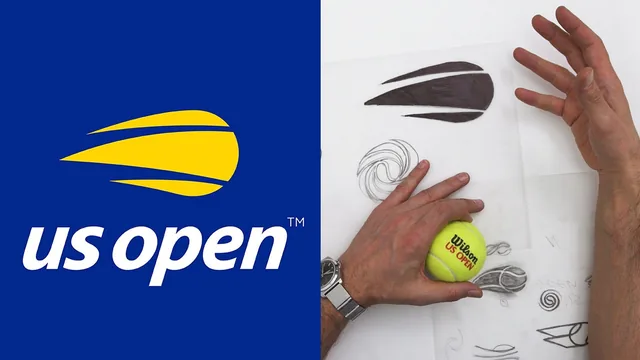
The back two-thirds is a single case study, the redesign of the US Open logo, walked through in real process order: research, problem definition, sketching, trademark and typography decisions, and client presentation. This is where the course earns its runtime. Haviv shows the actual research question the firm asked, whether "US Open" evokes tennis or golf, and the actual split in the results, 42 percent each, which forced the symbol to carry an explicit nod to tennis. He shows the recognition test on the old flaming-ball mark and the surprisingly weak 9 percent result, and explains how that data, not personal taste, defined the mandate: keep the idea, modernize the execution. Watching the sketch progression from a literal round ball to an abstracted, angular "swish" is a genuinely useful demonstration of how abstraction gets earned rather than guessed at.
What is missing
The course is explicit that it will not teach execution. Haviv says outright that vector tracing and Illustrator technique belong to other classes, and the transition from final sketch to finished logo happens off-screen, described as pulling a cooked chicken from the oven. That is an honest disclosure, but it means anyone hoping to learn hands-on drawing or software skill will come away empty-handed. Similarly, the criterion of "appropriateness," which Haviv himself calls the most important and most mysterious of the three, is explicitly not something he claims to be able to teach. He says as much, which is refreshingly candid, but it does leave the course's central concept resting on intuition the viewer has to develop elsewhere.
The presentation section, covering how to mock up a mark across merchandise, broadcast graphics, app icons, and embroidery, is short but practical, and the closing advice to always know your own favorite option before a client asks is a small, specific piece of professional wisdom worth remembering.
Overall this plays more like a condensed masterclass on process and philosophy than a skills tutorial. It rewards someone who already sketches and designs but wants to see how a top-tier identity firm structures research, defends decisions with data, and manages a client relationship. Anyone earlier in their design journey looking for technique will need to pair it with something more hands-on.
The standout
The walkthrough of testing the old US Open flaming-ball logo against 1,000 people, only 9 percent recognized it, and using that data to justify reinvention while preserving the underlying idea.
What you will learn
- How to judge whether a brand needs a symbol at all, versus just a logotype
- The three criteria used to evaluate any mark: appropriate, distinctive and memorable, simple
- How to structure client research, including direct interviews and quantitative recognition testing
- How to translate research findings into a defined design problem before sketching
- Why hand-sketching precedes digital tools, and how iterative abstraction refines a concept
- How to build a client presentation that mocks up the mark across real-world applications
Best for: Designers with some logo or branding experience who want a professional studio's actual client process, not beginner software tutorials.
Skip it if: Complete beginners looking to learn Illustrator, vector drawing, or hands-on sketching technique, since none of that is demonstrated.