
Design a Female Character: Exploring Copic Markers
Gabrielle Brickey · Portrait Artist - ArtworkbyGabrielle.com
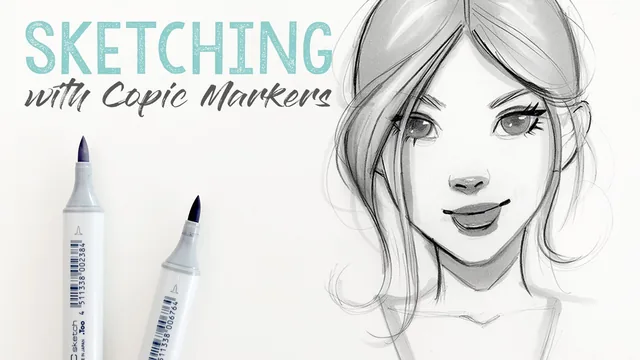
A short, focused add-on that teaches gray Copic marker shading for portraits, not a standalone beginner course.
A narrow, well-executed add-on
This class is explicit about its scope from the opening minutes: it is not a course on how to draw a face, but a follow-up that bolts gray Copic marker shading onto a sketching process the teacher assumes viewers already know, ideally from her earlier pencil-based character course. That framing is honest and useful for setting expectations, but it also means anyone arriving without that foundation will find the sketching lesson thin. The shape-breakdown explanation, two parallelograms for eyes, an upside-down triangle for the nose, a squished hexagon for lips, is covered quickly and treated as a refresher rather than a first introduction.
Where the course earns its keep is in the materials and shading sections. The materials lesson is unusually specific: it names paper types (HP Premium Choice LaserJet versus generic sketchbook stock), pencil leads (3H for sketching, 4B for details), and a clear breakdown of Copic Ciao versus Copic Sketch markers, including why a beginner might buy three N-range or C-range grays instead of an entire set. That kind of concrete, buy-this-not-that guidance is genuinely helpful for someone who has never shopped for alcohol markers and would otherwise be overwhelmed by Copic's 358-color catalog.
The shading demonstrations, split across two full character walkthroughs, are the heart of the class. The method is consistent and easy to follow: block in cast shadows with the lightest gray first, tone the irises and lips, then move to hair with a few confident sweeping strokes rather than dense scribbling. The reasoning behind sequencing, that markers cannot be lightened once applied so starting pale and building up avoids ruining a drawing, is a real technical insight rather than filler commentary. Equally practical is the warning to keep pencil sketches very light before marker work, since dark graphite can clog a Copic nib.
Strengths and limits of the format
The detailing lessons that follow round out the technique well: white gel pen highlights on eyes, nose, and lips, stump-blended pupils, and grouped lash clumps instead of individual lines. These are small moves, but they are the kind of finishing touches that separate a flat sketch from a polished character illustration, and showing them twice across two different faces reinforces the pattern without feeling repetitive.
The final stretch on alternative methods, digital sketching in Procreate followed by printing and coloring over the printout, plus light-box tracing and inking with a Copic multiliner, is a reasonable bonus but stays surface level. Each method gets a quick pass rather than a full demonstration of pitfalls, so it functions more as an idea prompt than a taught skill.
At fifty minutes, the course is compact and does not overstay its welcome, but it also does not build toward a single cohesive project so much as demonstrate the same technique twice with minor variation. There is no anatomy instruction, no color marker guidance, and no coverage of skin tones beyond a brief mention of toning the whole face first for darker complexions. Viewers should treat this as a technique supplement, not a complete character-drawing curriculum, and success with it depends heavily on already being comfortable with the sketching fundamentals it deliberately skips.
The standout
Establishing cast shadows first with a light gray marker, then building up to darker tones only after the lightest layer is down, so values can be snuck up on gradually instead of committed to too early.
What you will learn
- How to choose and use two to three gray Copic markers (Ciao vs Sketch, C-range vs N-range) for stylized portraits
- A shape-based approach to blocking in facial features and adjusting proportions for different character looks
- How to layer cast shadows, iris and lip tone, and hair strokes with markers before returning to pencil for detail
- Sequencing marker work before dark pencil work to avoid clogging Copic nibs with graphite
- Finishing techniques with white gel pen highlights, eyelash clumping, and pencil-and-stump blending
- Two alternative workflows: digital sketch-to-print coloring and light-box tracing with multiliner inking
Best for: Artists who already sketch stylized female character faces and want a simple, repeatable way to add gray-tone shading with Copic markers.
Skip it if: Absolute beginners with no drawing experience, or anyone wanting full color marker work or in-depth anatomy and proportion instruction.