
Daily Practice: 14 Day Mindset Art Challenge
Ohn Mar Win · Illustrator Artist Educator
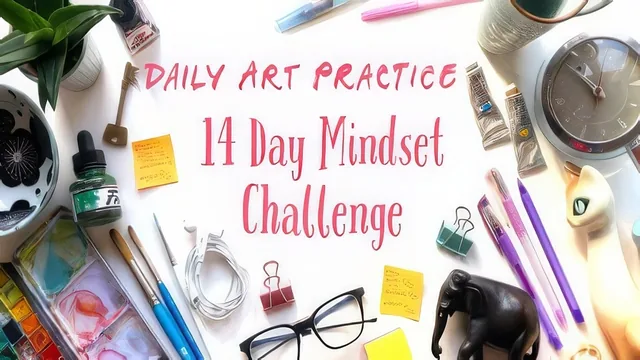
A 172-minute mindset course that trades drawing instruction for habit psychology, honest and useful if you already know how to sketch but tired of quitting your practice by day 10.
What the course actually teaches
Ohn Mar Win's "Daily Practice" is not a drawing class in the usual sense. It never demonstrates shading, perspective, or how to hold a brush. It is a habit-formation class that happens to use sketching as the vehicle. The teacher's credibility rests on having completed multiple 30, 100 and 365-day art challenges and filled over 20 sketchbooks, and she opens by walking through her own early work, starting with a single pear sketched on printer paper in 2014, to show that the daily habit came before the skill, not after.
The structure is a 14-day challenge broken into a fixed daily ritual: six minutes of timed sketching using whatever pens, pencils or paint are already in the house, followed by a break, then a four-minute "caring critique" where the sketch gets scored on enjoyment, confidence and progress rather than judged as good or bad. Materials are deliberately basic, ordinary printer paper and biros, so nothing feels precious enough to block starting. A full lesson is spent walking through her own home, bookshelf to kitchen drawer, to demonstrate that subject matter is never actually scarce, just unnoticed.
The mindset framework
The course's real content is a set of psychological tools introduced one at a time across the second half: intention-setting before each session, taking a mandatory break before reviewing work, reframing critical self-talk, tolerating the discomfort of trying new mediums, and adapting when a sketch goes wrong mid-line. Each tool gets a short explanation followed by the teacher applying it live on camera to her own 14-day attempt, narrating her scores and reasoning as she goes.
This live modeling is the course's strongest asset. Watching an experienced illustrator admit a wooden elephant sketch scared her, or that a thin-nibbed pen makes her "faff" and overwork lines, does more to normalize an amateur's frustration than the surrounding theory does. The section on vulnerability, which draws on Brene Brown's work on fear and creative exposure, earns its place because it is tied to a specific, visible failure rather than left abstract.
Where it falls short
The course runs long for how little new ground it covers after the first third. Several lessons repeat the same point about reframing language and finding household objects with only minor variation, and the day-by-day sketching footage, while honest, becomes repetitive once the format is established. There is no discussion of how to evaluate actual drawing improvement, line quality, proportion, composition, so a student hoping to leave with visibly better sketches will be disappointed; the visible growth here is emotional, not technical.
The habit-forming theory itself is thin and occasionally hand-wavy, citing the "21 days to form a habit" idea only to dismiss it without much substitute evidence. The class works best as a companion to an existing sketching habit that keeps stalling, not as a first exposure to either drawing or productivity psychology. Anyone who already journals or has tried habit trackers before will find the tools familiar, just applied specifically to a sketchbook.
The standout
The caring critique method, rating each daily sketch on fun, confidence and progress out of ten rather than on how it looks, gives the habit a survivable, non-perfectionist feedback loop.
What you will learn
- How to structure a 14-day, 10-minutes-a-day sketching habit built around a six-minute timed session plus a four-minute review
- How to find unlimited subject matter for a practice by inventorying ordinary household objects room by room
- How to write a short daily intention statement before sketching to replace fixed expectations with openness
- How to run a 'caring critique' that scores each sketch on enjoyment, confidence and progress instead of judging it as good or bad
- How to reframe self-critical language ('I can't draw well') into forward-looking statements without denying the difficulty
- Why taking a five-minute break between sketching and reviewing changes how you assess your own work
Best for: Artists who already have basic drawing or painting ability and have started, then abandoned, daily practices before and need a structure for consistency rather than new technical skills.
Skip it if: Complete beginners hoping to learn how to draw, or anyone wanting demonstrated technique, composition or medium-specific instruction rather than habit psychology.