
Creative Writing Bootcamp: Start a Brand New Story
Myla Goldberg · Novelist, mammal, concerned citizen
A single 58-minute session of five timed writing sprints that turns eavesdropped dialogue and childhood memories into a working character.
A timer, a notebook, and five sprints
Myla Goldberg's class answers one narrow question: what do you write when you have nothing to write about. It does not try to teach plot, structure, or revision. Instead it hands over a sequence of eight-minute timed exercises, each one designed to produce a scrap of material that can later become a scene, a character, or a story seed. The class runs less than an hour including instructions, so most of that time is the participant's own writing, not Goldberg's talking.
The arc is deliberately cumulative. It opens with an empathy exercise (write a scene from the point of view of someone you dislike), moves to eavesdropping (collect real, overheard dialogue from strangers or a TV playing in the next room), then fuses the two into an invented conversation, then interrogates that conversation to build a full character using a fixed list of questions borrowed from cartoonist Lynda Barry, and finally locates that character inside a hand-drawn map of a half-remembered childhood tree. Each stage's output becomes raw material for the next, so by the end a writer with a blank page thirty minutes earlier has a person, a place, and a scrap of dialogue to work from.
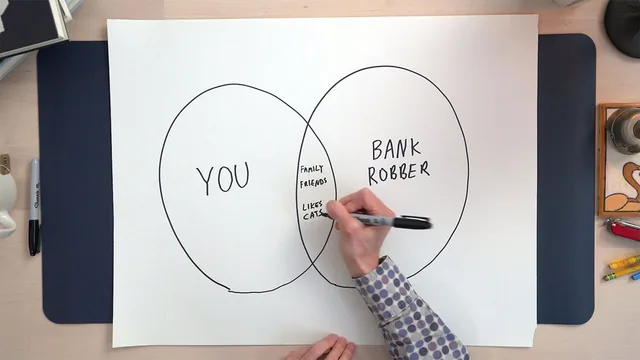
The strongest single tool is the empathy Venn diagram. Rather than telling writers to simply "understand their villain," Goldberg walks through a concrete method: draw two overlapping circles, one for the writer and one for a difficult character (her example is a bank robber), find something genuinely shared (a love of cats, say), and use that overlap as a bridge into territory that has no overlap at all, such as why this particular person believes robbing a bank is the right thing to do right now. The reframe she offers, asking what if this person is doing the best they can, is simple enough to apply immediately and specific enough to actually change how a scene reads.
The eavesdropping exercise is nearly as useful, mostly because of the debrief that follows it rather than the exercise itself. Writers are sent out to copy down three lines of real overheard speech from two separate conversations, and the payoff comes when Goldberg points out that real speech rarely arrives in tidy, complete sentences the way dialogue in early drafts often does. That gap between what people actually say and what beginning writers assume they say is a genuinely useful correction, delivered through direct experience rather than a lecture.
Where the class runs thin is in what happens after the sprints end. Nothing here addresses turning a character sketch or a mapped setting into an actual scene with rising stakes, nor does it touch revision, structure, or how a short story differs from a novel opening. The closing distinction between autobiographical fiction and personal fiction, using real feeling as raw material without transcribing real events, is a genuinely useful idea for anyone nervous about writing thinly veiled versions of people they know, but it arrives in the final minutes as a concept rather than an exercise.
This is a generative tool, not a craft course. It is well suited to a writer staring at a blank page who needs momentum, and far less suited to someone who already has a draft and needs help finishing it.
The standout
The empathy Venn diagram, where a hated or villainous character is anchored first in overlapping traits with the writer and then pushed into unfamiliar territory, giving antagonists a reason instead of a black hat.
What you will learn
- How to build empathy for an unlikeable or antagonistic character using a two-circle Venn diagram of shared traits
- How to eavesdrop in public (or via TV/radio) and mine three real overheard lines per conversation for authentic dialogue
- How to write a scene from a hated person's point of view to break out of a single narrative voice
- How to build a full character profile from a stranger's dialogue using a fixed set of questions about appearance, wallet contents, fears, and desires
- How to fuse a personal childhood memory (mapped as a tree and its surroundings) with an invented character to create a setting
- How to turn autobiographical material into personal fiction instead of a thinly veiled memoir
Best for: Writers with an idea drought who want fast, structured prompts to generate raw material for a new story in under an hour.
Skip it if: Anyone wanting instruction on plot structure, revision, or finishing a manuscript, since this class stops at raw fragments and never touches shaping them into a story.