
Create a Short Documentary Video Portrait
Elaine McMillion Sheldon · Documentary Storyteller
A working filmmaker walks you through one real shoot start to finish, but the 53 minutes move fast and assume you already own gear.
One shoot, start to finish
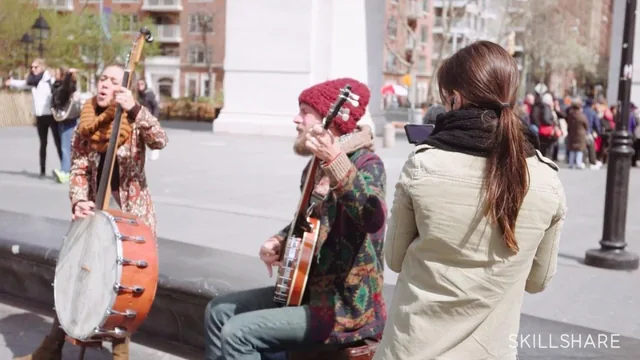
Elaine McMillion Sheldon structures this class around a single afternoon with Coyote & Crow, a busking duo in Brooklyn, and that choice is both the course's biggest strength and its main limitation. Rather than lecture abstractly about documentary theory, she shows her actual process: emailing friends to find a subject, running a short pre-interview over the phone, then showing up with a Sony FS5, a Canon 5D for stills, two shotgun mics with different windscreens for indoor and outdoor use, and a Tascam recorder to capture a clean 40-minute audio bed of the performance. The equipment lesson in particular is useful because it explains the reasoning behind each choice, not just the gear list, such as why she records audio separately from video when she knows she'll be starting and stopping the camera throughout a performance.
The shooting lesson is where the class earns its keep. Sheldon talks through thinking in scenes instead of shots, planning coverage like "Jamie putting on makeup" or "Thomas playing with the dog" as discrete beats rather than trying to capture everything. She also covers a genuinely practical continuity habit: waiting for a subject to exit a frame before running ahead to set up the next one, so that footage cuts together without jarring jumps. Her point about never asking a documentary subject to repeat an action is a useful ethical line that separates observational work from staged reenactment, and it's reinforced with a real moment where a refrigerator ruins an interview take and she simply moves rooms rather than demanding a redo.
Editing choices that hold up
The editing lesson is denser than its runtime suggests. Sheldon walks through withholding music for the first two minutes of the film so natural sound, like a butter knife scraping toast, can set atmosphere before any score enters. She also explains her use of L-cuts, letting audio from the next scene arrive before its picture, and her decision to change frame rates mid-shoot, from 24 to 60 to 240 frames per second, to add texture to specific emotional beats like hair moving in wind or fingers plucking a drum. Watching the finished film immediately after the breakdown, once with her narration and once without, is an effective teaching structure because it lets the viewer map each stated intention onto the actual cut.
Where the course falls short is pacing and depth. At 53 minutes covering research, gear, subject prep, shooting, editing, and pitching, several topics get compressed into a few sentences. Color correction is mentioned almost in passing, with a software name dropped and little explanation of the actual workflow. The pitching lesson at the end is similarly thin, naming a handful of outlets and gesturing at pricing your time without a concrete framework for what to charge or how a pitch email should be structured. Anyone hoping for a step-by-step editing tutorial inside Premiere, rather than a philosophy of when to use music and silence, will find the class more inspirational than instructional in that section.
This is best understood as a case study wrapped in a class. It rewards someone who already knows their camera, understands manual audio levels, and has edited before, since Sheldon never explains basic terms like L-cut or frame rate in depth, she simply uses them. For that intermediate viewer, watching one filmmaker's real decisions on a real shoot, and then seeing exactly how those decisions became a finished film, is more valuable than a generic overview would be.
The standout
The demonstration of holding music back until over two minutes into the film, letting natural sound like a butter knife scraping toast carry the early scenes instead.
What you will learn
- How to find and vet a documentary subject through research and a pre-interview before ever picking up a camera
- A minimalist one-person audio-visual kit for run-and-gun shoots, including dual shotgun mics and a separate field recorder for clean music beds
- How to shoot in scenes rather than chasing coverage, and how to anticipate action instead of asking subjects to repeat it
- Editing choices for pacing, including L-cuts, withholding music until natural sound has set the scene, and using frame-rate changes for texture
- How to structure a short documentary's arc, from a mysterious cold open to a delayed reveal of faces to a payoff performance
- How to pitch a finished short to outlets like Op-Docs or niche regional publications and think about pricing your time
Best for: Someone who already owns a camera and audio gear and has shot some video, and wants a real-world case study in turning one afternoon with a subject into a polished short.
Skip it if: Total beginners with no camera experience or equipment, since the class assumes working knowledge of manual audio levels, frame rates, and an NLE like Premiere.