
Concept Art: Drawing Imaginary Worlds
Ira Marcks · Graphic Novelist
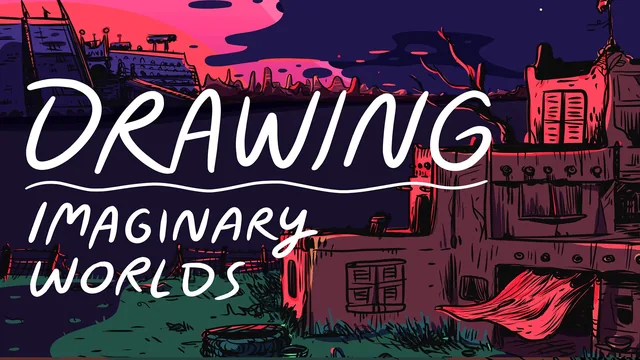
An 88-minute masterclass in world-building theory that treats the pencil work almost as an afterthought worth taking anyway.
A course about thinking before a course about drawing
Concept Art: Drawing Imaginary Worlds spends roughly its first two-thirds on a subject most drawing classes skip entirely: how to reason about a fictional world before touching a pencil. Ira Marcks opens with a case for why fantasy and science fiction deserve to be taken seriously as craft, citing Tolkien's wartime service and Orwell's time with the Home Guard as evidence that invented worlds grow out of real experience rather than escapism. From there the course builds a genuinely useful analytical tool: a four-part question set (when, where, what, why) demonstrated against Ralph McQuarrie's original Mos Eisley concept painting for Star Wars. Marcks reads the painting's clues, primitive architecture, a low-tech spaceship, twin suns, to show how an audience infers an entire backstory from a handful of visual decisions.
The middle section on civilization-building is the course's most original contribution. Marcks pulls a random premise from an online world generator, something to the effect of an aggressive civilization known for sports, architecture and music that collapsed from unsustainable farming, and then works backward through Roman history to build a vocabulary of details: the imperial cult, gladiatorial games rooted in military training, the load-bearing arch. He repeats the exercise with the same premise's second half, this time drawing on Miyazaki's Nausicaä of the Valley of the Wind to invent a toxic, monster-filled future instead. Watching him toggle between historical research and fictional precedent for the same starting sentence is a clear demonstration of how the same premise can be sonically differentiated into two believable civilizations, and it is more transferable than most world-building advice, which tends to stop at "just imagine details."
Where the course changes register is the drawing demonstration in its second half. Marcks builds a single illustration, a farmhouse in the foreground of a post-apocalyptic desert with a Colosseum-like stadium looming behind, and walks through composition, inking and coloring in real time. The depth lecture, covering horizon placement, scale, overlap and foreground-to-background contrast, is clearly explained but covers ground any general drawing course would touch on. The inking section is stronger, with specific attention to how line weight alone can suggest mass, shadow and material without added rendering. The coloring stage, built on a Pantone palette pulled straight from that site's sample sets, is the most technically thin part of the course. It works as a demonstration of decision-making, when to darken sand for mood over accuracy, when to strip back shadow layers, but it never breaks down color theory the way the tonal-plane section breaks down value.
The class project is intentionally loose, inviting a sketch, a photo edit, or even a short piece of writing rather than a finished illustration, which fits the course's real center of gravity. This is fundamentally a course about the intellectual scaffolding behind concept art, not a technical drawing tutorial, and it succeeds best at that. Anyone hoping for step-by-step instruction in perspective, anatomy or digital painting technique will find the demonstration useful but thin. Anyone who already draws and wants a sharper process for inventing a coherent, detailed world before they start sketching will get real, reusable value from the first two-thirds alone.
The standout
The tonal-plane exercise, where Marcks strips Ralph McQuarrie's Mos Eisley painting down to four grey values before touching color, gives a transferable framework for reading and building any image's light structure.
What you will learn
- How to interrogate a fictional world with the who/what/where/when/why framework used to break down Ralph McQuarrie's Mos Eisley painting
- How to match a story's time period (fantasy, heightened reality, alternate reality, sci-fi) to its relationship with nature for instant tonal coherence
- How to reverse-engineer a civilization's culture, sports, architecture and technology from a single generated premise, the way Ira Marcks builds a Roman-inspired society from one sentence
- How to construct visual depth through horizon placement, scale, overlap and foreground-to-background contrast
- How to build tonal planes in four values before introducing color, then layer a chosen palette on top with purpose
- How to use line weight in inking to imply mass, movement and shadow rather than flat outlines
Best for: Writers, game designers and illustrators who already draw competently and want a structured way to invent coherent fictional settings before diving into linework.
Skip it if: Absolute beginners looking to learn fundamental drawing skills, since the course assumes basic draftsmanship and spends most of its runtime on concept and theory rather than technique.