
Color Collector: Explore the Art of Color Mixing With Gouache
Marie-Noëlle Wurm · Artist, illustrator, HSP
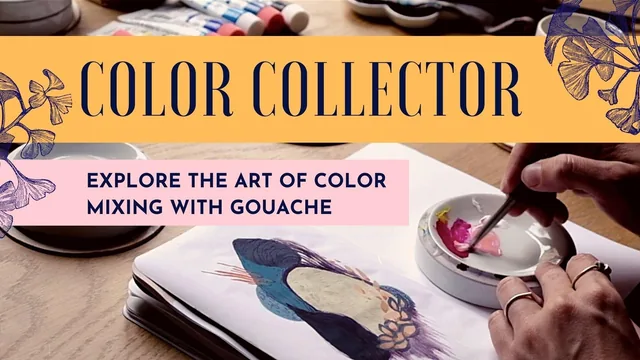
A 231-minute deep dive that turns basic gouache color mixing into a disciplined, repeatable skill rather than a lucky guess.
A color theory course built on repetition, not shortcuts
Marie-Noëlle Wurm's "Color Collector" is not a class about painting pictures. It is a class about training the eye and hand to recognize and reproduce color relationships, using gouache (or acrylic) as the vehicle. The premise is deliberately narrow: work only with a limited palette of black, white, and three primaries, no premixed greens or purples allowed. That restriction is the engine of the whole course. By forbidding shortcuts, it forces every green, every purple, every gray to be built from scratch, which is exactly the muscle most self-taught painters never develop.
The first half of the course is structured like a lab manual. Learners build a ten-step value scale from white to black, then repeat the process with tints and shades of each primary, then construct a full color wheel by hand using a compass or a household object as a stencil. From there it moves into warm and cool color bias, complementary grays and neutrals, and skin tones built from the same complementary logic. This section is intentionally repetitive, and the instructor says so directly, framing tedium as the price of real fluency rather than apologizing for it. The complementary-gray exercises are the strongest material in the course: mixing a color with its opposite in small increments to chart a path toward neutral gray teaches a concept that most painting classes gesture at but few actually drill.
The second half pivots into open-ended creative prompts: monochrome studies, paintings translated from music, two versions of the same composition in different color schemes to compare mood, and a closing challenge to design five original palettes without further guidance. This section trades precision for exploration, and it works best as a payoff for having done the technical grounding first, since the creative exercises repeatedly reference concepts (complementary grays, color bias, tints and shades) introduced earlier.
What holds up and what doesn't
The pacing philosophy is honest rather than aspirational. The instructor explicitly tells learners they can do as many or as few exercises as they like, and structures the class so the technical and creative halves can be approached in either order. That flexibility is a real strength for a 231-minute course that could otherwise feel like homework.
The weak point is density. Because nearly every lesson is a swatch-building exercise, the course leans heavily on the viewer's willingness to sit with repetitive, unglamorous mixing work for long stretches before anything resembling a finished piece appears. There is little discussion of composition, brush handling, or paint application beyond color itself, so anyone hoping for general painting instruction will find the scope narrower than expected. The color wheel construction segment also relies on freehand geometry (finding a triangle's midpoint by eye, eyeballing equal box widths) which works fine for the instructor's demonstration but will frustrate anyone who wants precision without a compass and ruler.
Where the course earns its length is in follow-through. Skin tones, complementary neutrals, and color proportion are each treated as their own subject rather than a single rushed lesson, and the closing stretch asks learners to revisit whichever exercise felt weakest, which is an unusually self-aware structure for a class this size. For someone willing to put in the swatch-building hours, the payoff is a genuinely internalized sense of how far a small paint set can stretch.
The standout
The complementary-gray exercise, where mixing a hue with its opposite by increments reveals a whole family of neutrals most painters never intentionally build.
What you will learn
- Build systematic value scales from pure white to pure black to train tonal judgment
- Mix tints and shades of each primary and construct a full hand-drawn color wheel from scratch
- Find complementary grays and neutrals by balancing opposite hues on the wheel
- Mix a range of skin tones using the same complementary-mixing logic
- Understand how color proportion and placement change a painting's mood independent of the palette itself
- Apply technical color knowledge to open-ended creative prompts like translating music into color
Best for: Painters who already handle a brush but feel shaky or intuitive about color mixing and want a structured, repeatable system for it.
Skip it if: Absolute beginners looking for step-by-step finished paintings, or anyone wanting fast results without tedious swatch-building.