
Collage & Go: Explore paper cutouts + mixed media
Lucie Duclos · Design + Mixed Media
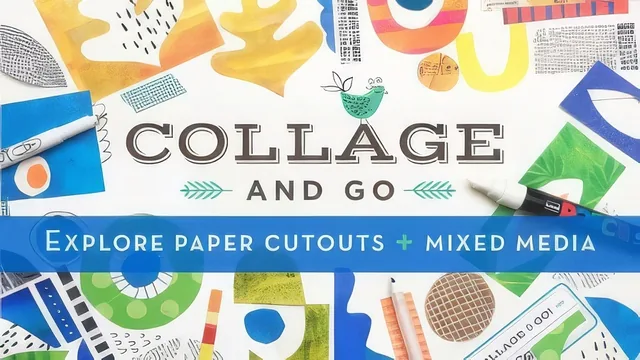
A 38-minute low-stakes primer on cutting and gluing paper scraps, built more on mood than technique depth.
Collage & Go is a short, casual introduction to paper collage aimed squarely at people who have never picked up a glue stick with intention. Across ten brief lessons totaling under 40 minutes, Lucie Duclos walks through gathering materials, altering found paper, cutting basic shapes, and assembling a finished piece. It is less a technique course than a permission slip: here is how little you actually need to start.
What it actually teaches
The materials lesson runs through card stock, a glue stick, scissors, Posca paint markers, a white gel pen, and sources of collage paper like old maps, sheet music, dictionaries, and sandpapered magazine pages. This inventory doubles as the course's most practical content, since much of what follows is really about creatively degrading these papers rather than combining them in complex ways. Sanding a glossy magazine page to dull its shine, drawing thin white lines with a paint marker, or stamping a plaid pattern onto kraft paper are all shown as quick, repeatable moves that any beginner can copy immediately.
The strongest single idea in the course is the negative-space cutting exercise in "Drawing with Scissors." Cutting a rectangle, pulling shapes out of its edges, then recombining the positive and negative pieces in different arrangements is a compact, genuinely useful way to generate collage vocabulary without overthinking composition. It is the one segment that teaches a repeatable skill rather than just a mood or a supply list.
The organizational advice, sorting paper scraps into labeled freezer bags by category such as music, maps, patterns, and text, is practical for anyone who already accumulates paper ephemera, though it is closer to a storage tip than an artistic technique.
Where it falls short
The assembly lesson, where the actual collage gets made, moves quickly and loosely, with commentary that leans on intuition ("I don't know why, but I like to use this") rather than explaining why certain pairings of shape, color, or paper work. Beginners looking for a framework for composition, how to balance color, scale, or focal point, will not find one here. The class project offers two options: a 15-circle exercise or a themed personal collage, but neither comes with concrns criteria beyond "have fun," so there is little to self-assess against once the cutting is done.
The course also assumes a fairly specific aesthetic, bold mid-century shapes, muted vintage paper, a graphic-design sensibility drawn from Matisse cutouts and Rex Ray album covers, and doesn't offer alternate directions for someone who wants a different visual language. For total beginners this is a gentle, low-cost, well-organized on-ramp with a couple of genuinely reusable ideas, the paper-altering tricks and the negative-space cutting drills. For anyone who already collages or wants deeper instruction in composition and color, it will feel thin, more a mood board with narration than a structured lesson plan.
The standout
The negative-space cutting exercises, splitting a shape and reassembling its pieces to invent new forms, give a genuinely transferable compositional habit beyond this one project.
What you will learn
- How to alter plain magazine or kraft paper with sandpaper, paint pens, and white gel pens to add texture and line work
- How to sort and store paper scraps by category (music, patterns, maps, words, solids) using freezer bags and labels
- How to cut and rearrange negative and positive space through simple 'drawing with scissors' exercises on basic shapes
- How to build a themed or circle-based collage from assembled paper scraps using a glue stick
- Where to look for collage inspiration, including specific artists and books like Rex Ray and Jane Davies
Best for: Total beginners who want a low-pressure, materials-light creative outlet and don't need technical rigor or a finished polished piece.
Skip it if: Anyone with prior collage or paper-art experience looking for advanced composition, color theory, or a structured critique of finished work.