Character Design: Drawing People in Motion
Ira Marcks · Graphic Novelist
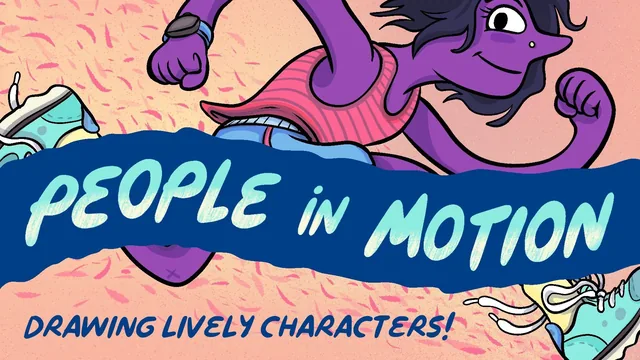
A brisk, personality-driven walk through posing a running character, best suited to cartoonists who already draw but want livelier poses.
A pose-first approach to bringing characters to life
Ira Marcks frames this course around a single, well-chosen problem: how does a static drawing suggest movement and personality at a glance. Rather than teaching anatomy or animation timing, the class narrows in on one moment, a running or walking pose, and walks through the decisions that make it read clearly. The opening lessons ground this in Marcks's own comics work and in touchstones like Calvin and Hobbes, the Spider-Man pose, and the contrast between Fone Bone and Thorn in Jeff Smith's Bone. These references do real work: they show how exaggeration signals emotional register, and how a more grounded, human pose reads differently than a rubber-hose cartoon body bending past what gravity would allow.
The technical core arrives in the framing and articulation lesson, where a plain stick figure gets shoulders and hips added so it can hold a pose at all, then an action line, essentially the character's spine, that carries the emotional tone of the pose. From there the course narrows further into a practical checklist: 14 points of articulation (neck, shoulders, elbows, wrists, hips, knees, ankles) that need to be accounted for so a figure doesn't look stiff, and a habit of testing a pose as a flat silhouette or at postage-stamp size to confirm it reads before any details go on. This is the most useful idea in the class, a fast, repeatable way to self-critique a pose before committing time to rendering it.
The back half moves through sketching, inking, and coloring in quick succession. The inking segment covers Micron markers versus a calligraphy nib in real, specific detail, including the fact that a nib requires pulling strokes toward the body rather than pushing away from it. The coloring lesson introduces the triadic method: pick a main color, its complement, then a third hue one step off the complement, which gives a simple formula for a bold, cohesive palette without needing formal color theory. Both segments are demonstrated on paper first and then repeated digitally in Clip Studio Paint, which makes the techniques usable regardless of whether a student draws traditionally or on a tablet.
Where the course is thinner is in exactly the areas it deliberately skips. Anatomy gets almost no attention beyond basic torso shapes like the pear form popularized by 1930s Disney and Fleischer cartoons. Facial construction is waved off with a promise that it's covered elsewhere. And because the whole class builds toward one pose, students hoping for a broader toolkit of poses or a real walk-cycle animation lesson will find only a single variation exercise near the end, where Marcks reworks the same pose into a determined sprint and an exhausted trudge.
As a 87-minute class, it delivers a tight, opinionated method rather than a comprehensive course. It rewards someone who already has basic drawing chops and wants a sharper eye for what makes a pose convincing, not someone starting from zero. The class project, a fully inked and colored running character, is achievable in under an hour by design, which makes the course feel efficient rather than padded.
The standout
The silhouette test, shrinking a pose down to postage-stamp size to check if it still reads clearly, is a simple, transferable diagnostic any illustrator can use immediately.
What you will learn
- How to build an articulated stick figure with 14 points of articulation instead of a stiff, immobile frame
- How to use the action line to convey a character's emotional state through spine curvature
- How to select the clearest pose from a walk cycle by testing silhouette readability at small scale
- How to push a pose past realism for energy without breaking the character's believability
- How to ink with a calligraphy nib or felt-tip marker for line weight and personality
- How to apply the triadic color method to build a simple, high-contrast palette
Best for: Illustrators and comic artists with basic drawing skills who want sharper, more expressive character poses and a repeatable workflow from sketch to final art.
Skip it if: Absolute beginners with no drawing experience or anyone seeking in-depth anatomy, animation, or software tutorials rather than pose and storytelling concepts.