
Character Design Crash Course: Dynamic Design in Four Steps
Melissa Lee · allow yourself to fail before you succeed
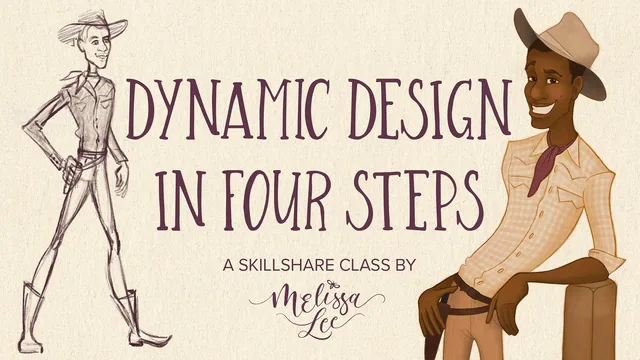
A working artist walks you through her real four-step character design process, but 61 minutes covers a lot of theory and not much drawing.
Melissa Lee's crash course promises a four-step character design process, and it delivers on that structure cleanly. Story, roughs, design, and cleanup and color each get their own lesson, bookended by a fundamentals lecture and a grab-bag of warm-up exercises. For a 61-minute class, that is a lot of ground, and the pacing shows it. Roughly half the runtime goes to theory before a single character concept appears.
The fundamentals lesson is the strongest stretch. Lee names four pillars, shape, silhouette, rhythm, and construction, and backs each with a specific, checkable rule: shoulder width runs about three heads across, the elbow lines up with the navel, the golden ratio's 1:1.618 shows up in finger joints and in the Parthenon. She also names two failure modes worth remembering on their own: the "ladder" (everything parallel and equidistant, which reads as static) and the "bowling ball" (facial features all the same size, which reads as flat). Pairing those with fixes, tilt the hips and shoulders, vary feature sizes, gives a beginner something to check their own drawing against rather than a vague sense of "make it more interesting."
The design walkthrough
Once the class moves into actual character-building, it follows a single cowboy character named Toby from concept through finished color. The story step is refreshingly concrete: Lee ties the character to a specific historical detail (the word "buckaroo" as a corruption of the Spanish "vaquero") and explains how she names characters, cross-references Pinterest boards for costume reference, and contrasts two characters' body types on purpose. The roughs stage covers thinking of the body as three connected shapes and flipping the canvas horizontally to catch construction errors, a small but genuinely useful habit. The design stage, where features get pinned down, spends a fair amount of time on Lee's own process anxieties and comparisons to other artists rather than on technique, which is honest but eats into demonstration time.
The cleanup and color lesson is the most hands-on segment, walking through line cleanup at low opacity, a rosy-cheek trick using blurred triangles, and a shading method built on duplicating a color layer and adjusting hue and saturation with a masked opacity drop. These are practical, tool-specific steps (Photoshop and Procreate menu paths included) rather than abstract advice, and they are the closest the course gets to a repeatable recipe a viewer could follow along with immediately.
Where it falls short
The drawing exercises lesson, meant to build gesture and observation skills, is described rather than demonstrated in any depth, which limits how much a viewer can absorb without pausing to try each one independently. The inspiration segment is largely a list of artists to look up (Stephen Silver, Aaron Blaise, J.C. Leyendecker, among others) with brief commentary, useful as a reading list but thin as instruction. And a meaningful chunk of the design and closing lessons drifts into encouragement about not comparing yourself to other artists, which is well-intentioned but dilutes the technical content a "crash course" implies.
As a beginner-to-intermediate refresher on character design vocabulary and process, the course does what it says on the label. As a step-by-step drawing tutorial, it is lighter than the title suggests, better at explaining what makes a design work than at showing, blow by blow, how to make one from scratch.
The standout
The golden ratio and 'avoid the ladder / avoid the bowling ball' shape-variation principles give a concrete, checkable framework for why a design does or doesn't read as dynamic.
What you will learn
- The four core design principles: shape, silhouette, rhythm, and construction
- How to read and apply basic human figure proportions (three heads across the shoulders, elbow at the navel, and so on) to inform stylized exaggeration
- Practical warm-up drills including blind sketching, 10-second gesture drawing from sports footage, and tracing animated frames for muscle memory
- How to build a character from a written backstory through rough thumbnails to a refined, posed design
- A simple digital cleanup and flat-color workflow, including a quick trick for rosy cheeks and adding gradients over flat color
Best for: A beginning cartoonist who already has basic drawing chops and wants a structured process and vocabulary for turning a character concept into a finished design.
Skip it if: Someone with zero figure-drawing experience, since the anatomy and construction talk assumes you can already draw a basic body and moves fast through terms like tangents and negative space.