
Beginner Figure Drawing Fundamentals - Gesture and Construction
JW Learning · Drawing the Body, Head and Hands
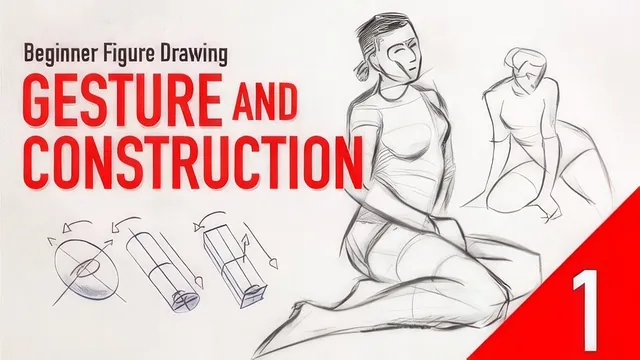
A dense, well-sequenced explanation of gesture and construction that rewards patience but shows nothing of feedback or refinement over time.
This is a course about vocabulary and mindset as much as it is about drawing. Its central move, repeated from several angles across the first ten lessons, is splitting figure drawing into two ideas: construction (the three-dimensional forms that make up a body) and gesture (the curved line of movement that connects those forms and gives them life). The teacher circles this distinction patiently, using a house-building metaphor (walls and doors are construction, the thing that makes it a livable home is gesture) and later a mechanical one, describing the body as a machine of moving parts that the artist has to control and connect.
Once the terms are set, the course builds a toolkit rather than jumping to full figures. It works through three basic forms (sphere, box, cylinder) and shows how to convert flat outlines into three-dimensional shapes with cross-contour lines, the loops that wrap around a form the way string would wrap around a package. From there it introduces three line types for gesture work, the C-curve, reverse C-curve, and straight line, and makes the case that curves alone create the sense of a living, moving figure while straight lines kill that motion. A section on positioning adds a genuinely useful physical technique: holding an ordinary pencil, using its printed stripe as a straightedge, and moving it against a reference image or real object to judge whether a form is leaning, tilting, or facing a particular direction. It is a low-tech trick, but a practical one that a beginner can use immediately without understanding formal perspective.
Demonstrations and Practice
The four short demonstrations (head, arm, leg, torso) each follow the same visible process: lay down the longest gesture line first, build a simple form over it, then add a secondary pass of lines to refine while trying not to lose the original rhythm. The teacher narrates decisions out loud, including where to place a "corner" on a rounded shape like the head, using the eyebrow line as the pivot point. This think-aloud approach is the course's strongest teaching device, since it shows the reasoning behind a mark rather than just the mark itself.
The timed drawing sections, two-minute and five-minute poses done over reference images, are where the ideas get tested under pressure, and the teacher's narration during these stretches often repeats the same point made earlier (choose the biggest shape first, don't chase details, gesture and construction can be built in either order depending on the pose). That repetition works as reinforcement for a true beginner but will feel like padding to anyone who absorbed the terminology on the first pass.
Where It Falls Short
The course stops well short of assembling a complete figure with all limbs connected in a finished pose, and it does not touch proportion, which the teacher explicitly defers to a later lesson in the series. There is also no feedback loop built into the course itself. The teacher mentions posting timed drawings to a class discussion area for comment, but the lesson content never shows a critique of a student attempt, so a viewer has no model for what a corrected mistake looks like. For a beginner willing to treat this as the first of several linked lessons rather than a stand-alone class, the pacing and terminology make sense. For anyone expecting a single self-contained course that gets from blank page to a complete, proportioned figure, it will feel like exactly one-third of the job.
The standout
The 'longest curved line' method for locating a figure's gesture, paired with the reminder to exaggerate that curve beyond what the reference shows, is a genuinely transferable trick.
What you will learn
- How to define and separate gesture (the curved rhythm line of a pose) from construction (the three-dimensional forms of the body)
- Building a mental library of three basic forms (sphere, box, cylinder) and adapting them into body parts like the egg-shaped torso or tapered forearm
- Using a pencil held at arm's length as a simple tool to judge lean, tilt, and facing direction of forms in space
- Reading overlap between body parts by tracing a contour line as it passes from one form into the next
- Applying S-curves, reverse S-curves, and straight lines deliberately to add or remove fluidity from a pose
- Working through short 2 and 5 minute timed gesture drawings from reference images
Best for: A true beginner who has never had figure drawing terminology explained and wants a clear conceptual starting point before layering on more technique.
Skip it if: Anyone who already knows the gesture-versus-construction distinction, or an artist wanting hands-on feedback and correction rather than a lecture-plus-demo format.