
Basics of Perspective in Illustration: Drawing Scenes in Procreate
Iva Mikles · Illustrator | Top Teacher | Art Side of Life
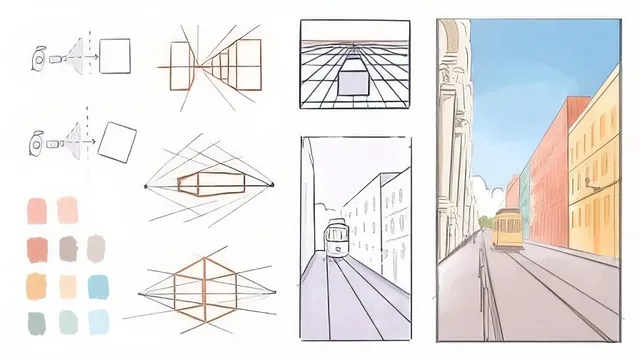
A tight 33-minute primer that turns perspective theory into simple boxes, grids, and real photo traces you can copy immediately.
Iva Mikles' class does one thing and does it efficiently: it walks a beginner through the full ladder of linear perspective, one vanishing point at a time, in well under 40 minutes. The structure is the strongest part of the course. It opens with 1-point perspective on a straight road receding to a single point, adds a second vanishing point to build a house with a tilted roof, then stacks on a third point for towering or plunging views of buildings. Each stage builds visibly on the last, and a dedicated "Comparison" lesson pauses to contrast 1-point and 2-point setups side by side using a simple box and a stick figure to show where the viewer is standing. That comparison lesson is a smart pedagogical choice that many perspective tutorials skip, and it does more to cement the concept than another round of new vocabulary would have.
The teaching method leans heavily on demonstration over explanation, which suits the subject. Every concept gets a real photo example: a Lisbon street for 1-point, a building facade for 2-point, an elevated townscape for 3-point. The instructor traces the photo's edges with a perspective grid switched on in Procreate, first drawing over the lines directly, then later just eyeballing the same grid from memory. That progression, from traced photo to imagined grid, is quietly the most useful pedagogical device in the class, since it models how a student should actually practice outside the lesson.
Where the class thins out
Foreshortening and aerial perspective, the two lessons that arguably require the most nuance, get comparatively brief treatment. Foreshortening is explained mostly through the tilted top plane of a single box and a river-bend illustration, with no dedicated exercise on foreshortening a figure or a complex object, which is where students usually struggle most. Aerial perspective fares a bit better conceptually, covering how saturation, contrast, and blue color shift fade with distance, but it stays descriptive rather than procedural. There is no walkthrough of building that fade in Procreate layer by layer, so a student has to infer the technique rather than replicate steps.
The class project asks students to draw a background incorporating one of the covered perspective types, optionally with characters, and post it for feedback. It is an appropriately scoped capstone for a short class, though it offers no rubric or checklist for self-assessment, leaving students to judge their own grid accuracy without guidance.
Who should take it
This is squarely an orientation class, not a skills workshop. It succeeds at making perspective feel approachable rather than mathematical, largely through its consistent real-photo comparisons and its refusal to overload any single lesson with too many rules. Students who already understand vanishing points and want to refine foreshortening on organic or figurative subjects will find little new here. But someone who has never deliberately set up a horizon line and vanishing point before will leave with a working mental model and a Procreate-specific workflow they can repeat on their own reference photos immediately after finishing.
The standout
Tracing a real street photo with a Procreate perspective grid overlay to extract clean one- and two-point vanishing lines is the single most transferable skill in the class.
What you will learn
- How to construct and use 1-point, 2-point, and 3-point perspective grids in Procreate
- How to place vanishing points relative to the horizon line to control eye level, including worm's-eye and bird's-eye views
- How to trace real photo references over a perspective grid to build buildings, streets, and landscapes
- How foreshortening distorts object edges as they recede in space, using a simple box example
- How atmospheric (aerial) perspective uses color saturation, contrast, and blue hue shifts to convey distance
- How to block in scenes using simple shapes (boxes, cylinders) before refining them into houses, trees, and figures
Best for: Beginner illustrators who already sketch but have never deliberately built a scene around vanishing points and want a fast, structured primer.
Skip it if: Anyone with prior perspective training, or artists who work outside Procreate and need software-agnostic or advanced technical drafting methods.