
Art Journaling for Self-Care: 3 Exercises for Reflection and Growth
Amanda Rach Lee · Artist
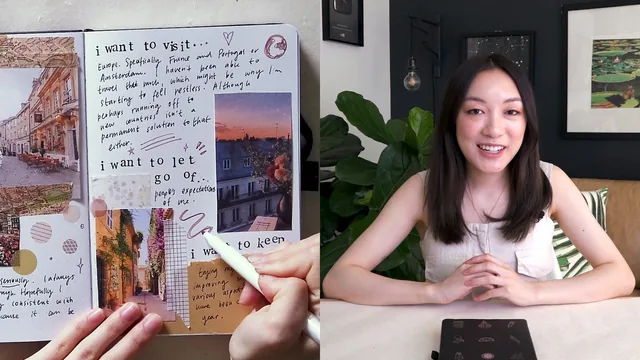
Amanda Rach Lee turns a blank journal page into a calm 39-minute self-reflection ritual, but the class is really three prompts, not a technique library.
Amanda Rach Lee's class opens with a plain premise: journaling clears her head, and she wants to hand over the three exercises she actually uses in her own notebooks. That framing sets expectations correctly. This is not an art fundamentals class, and it barely touches technique. It is a demonstration of three journal-page prompts, filmed while she fills them in real time, narrating her thought process as she goes.
Structure and the three exercises
The class runs through three spreads back to back. The first, "Your Current Mood," asks how you feel today, what made you feel accomplished, and what you have been enjoying. The second, "What You Want," is framed as a vision board: printed images from a source like Pinterest, arranged like puzzle pieces around prompts such as "I want to visit" or "I want to let go of." The third, "Who You Are Today," drops the pictures entirely and leans on handwriting and an affirmation stuck to the page, positioned as the emotional counterpart to the wanting exercise. The arc makes sense on paper: present, future, self. In practice each exercise plays out almost identically on screen, since Amanda answers her own prompts the same way each time, so the promised variety is more conceptual than visible.
What actually gets taught
The most reusable idea in the class is compositional, not decorative: start with the large elements (a lettered title, a photo), build outward into medium elements (washi tape, sticky notes), then fill remaining gaps with small doodles like starburst accent lines or wavy lines. It is a genuinely useful way to stop staring at a blank page, and it is demonstrated three separate times, so it sticks. Beyond that, the craft content is thin. Washi tape gets used as an adhesive for photos and Post-its rather than as a design element in its own right, and calligraphy lettering is mentioned only as something with a "whole separate class" behind it, not something taught here. Stamps appear in the second spread as an alternative to lettering, introduced with little more than "you need an ink pad and some stamps."
Where the class does deliver is in permission-giving. Amanda repeatedly tells viewers that a doodle does not need to be good, that answers can be one sentence or several paragraphs, and that a dark journal entry is worth keeping rather than avoiding. For anyone intimidated by a blank notebook, that reassurance is the actual product being sold, more than any specific skill.
The honest gap is depth. At 39 minutes across three near-identical demonstrations, the class covers one page-building method and three prompt sets, and that is close to the entire curriculum. There is no discussion of paper types, ink bleed, layout theory beyond "large to small," or how to develop a personal visual language over time. Viewers who already art journal will likely finish this having gained a few new prompts and one composition tip, not a new skill set. Viewers who have never opened a mixed-media journal will get a gentle, well-modeled first attempt and a clear sense that imperfection is fine, which for a self-care framing is arguably the more important outcome anyway.
The standout
The 'work large to small, then fill leftover gaps with simple accent doodles' method gives non-artists a concrete way to finish a page without it looking unplanned or empty.
What you will learn
- Three repeatable journal-spread frameworks: current mood, future wants (vision board), and present self-reflection
- How to build a spread from large elements down to small, working in layers rather than planning the whole page first
- Using washi tape functionally to secure photos and Post-its while adding decorative texture
- Filling awkward blank space with quick filler doodles (accent lines, stars, wavy lines) instead of leaving it empty
- Combining collage materials (printed images, ripped scrap paper, stamps) with hand lettering in one spread
- Writing open-ended journal prompts as page titles so the spread doubles as a structured workbook
Best for: Journal hobbyists and bujo-adjacent crafters who already own stationery and want emotional, low-pressure prompts to give their supplies a purpose.
Skip it if: Anyone hoping to learn drawing fundamentals, lettering technique in depth, or a structured mental-health journaling program.