
Anyone Can Watercolor: The Basics for Painting Magical Art Beginner Level
Yasmina Creates · Artist & Creativity Cheerleader
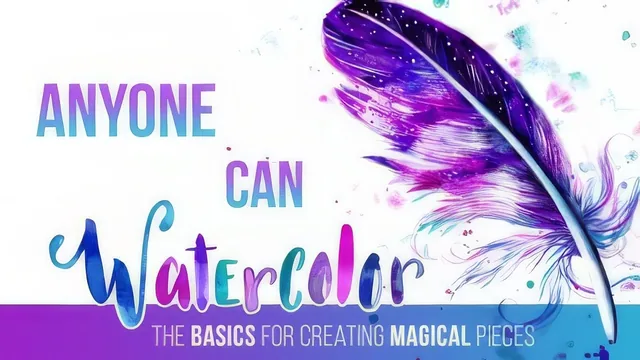
A tight 24-minute rundown of watercolor fundamentals that trades depth for speed, best treated as a checklist rather than a full course.
Anyone Can Watercolor is built around a simple premise: most people who quit watercolor quit because nobody explained the basics, not because the medium is actually hard. Yasmina Creates, a self-taught watercolor and mixed-media artist, spends the first third of the class on materials, then moves into wash techniques, then finishes with a guided project that ties the pieces together. At 24 minutes across 12 short lessons, it moves fast.
What the class actually covers
The materials section is the most practical part of the course. Rather than pushing expensive gear, the instructor recommends starting with one good round brush (she names a Kuretake Menso and a Silver Velvet squirrel-hair brush as her own picks) and one flat brush, explains why natural or natural-mimicking hair matters for holding water and releasing pigment evenly, and gives a clear rule for paper weight: nothing under 140 pounds. She also flags a specific budget pick, Canson XL, as the cheapest 140-pound paper she has found good results with. This section will save a beginner real money and real frustration, since it heads off the two most common early mistakes: cheap fraying brushes and paper that buckles or pills under water.
The technical core is the six wash techniques: wet-on-wet, dry-on-wet, wet-on-dry, dry-on-dry, flat wash, and gradient wash. Each gets a short demonstration and a one-line description of when to use it, for example dry-on-dry for tree bark texture or wet-on-wet for soft, edge-free backgrounds. This is a genuinely useful framework, since it names techniques a beginner might otherwise stumble into by accident without knowing what to call them or how to repeat them deliberately. The lesson on layering and blending reinforces the single most important rule in watercolor, that white paper is the only true white available and everything must be planned light to dark, which is worth the price of admission on its own for anyone new to transparent media.
Where it thins out
The one-color sphere exercise is the strongest teaching moment in the class, since it compresses layering, blending, lifting, and shadow logic into one small, repeatable shape rather than asking a beginner to manage all of it on a full painting immediately. The final feather project then applies masking fluid, salt texture, and layered color to a single subject, but the walkthrough moves quickly through steps like squinting at a reference photo to find dark values or building a background wash with deliberate paper gaps, without lingering long enough for a true first-timer to absorb the reasoning before the next step arrives.
The pacing is the course's central tradeoff. Because the whole class runs under half an hour, techniques like masking fluid application or the salt effect get one demonstration each with no time for repetition, troubleshooting, or common failure points beyond a quick tip here and there. A viewer who has never touched watercolor before will come away knowing what wet-on-wet is called but not necessarily how it feels to control on their own paper. This makes the class a solid orientation and vocabulary primer, not a substitute for practice time with a reference sheet paused beside the easel.
The standout
The one-color 3D sphere exercise, which forces a beginner to practice layering, blending, and lifting together in one small, low-stakes shape.
What you will learn
- How to choose brushes, paper weight, and paint types without overspending on gear
- Six distinct wash techniques (wet-on-wet, dry-on-wet, wet-on-dry, dry-on-dry, flat wash, gradient wash)
- How to layer, blend, and lift color while working light to dark
- Painting a 3D sphere using only one color to practice shadow, midtone, and highlight
- Masking fluid, salt, and rubbing alcohol as texture and highlight techniques
- Applying every technique together in a single feather painting project
Best for: Complete beginners who own no watercolor supplies yet and want a fast orientation before their first real painting session.
Skip it if: Anyone who has already painted a few watercolor pieces and needs technique refinement rather than a supply and vocabulary primer.