
Acrylic Painting: Learn the Basics For Beginners
LaurieAnne Gonzalez · Painter | Dog Lover | Bob Ross Wannabe
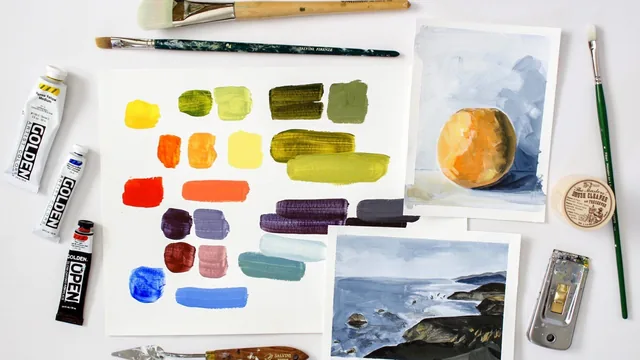
A generous, unhurried walkthrough of paint mixing, brushes, and mediums that teaches you to see like a painter, though it never quite finishes a painting.
What it actually covers
This class is built around six subjects rather than one throughline: workspace, color mixing, brushes, texture, dimension, and depth of field. That structure makes it closer to a materials orientation than a single lesson with a beginning and end. The workspace section is refreshingly unpretentious: a kitchen table doubles as a studio, a spare piece of kitchen glass becomes a palette, and an Ikea utility cart holds the rest of the supplies. That framing does real work for anyone intimidated by the idea that painting requires a dedicated room.
The color-mixing block is the strongest stretch. Working from just three primaries (a yellow, a cadmium red, and ultramarine blue) plus black and white, the demonstration walks through orange, purple, green, and a series of tints and shades, narrating the logic out loud as each mix goes down. The best moment is a genuinely useful discovery: mixing black into yellow yields a warm olive green, a combination the instructor stumbled into during an earlier landscape series and now returns to often. That kind of specific, hard-won knowledge is worth more than a color wheel diagram, and the class includes one of those too for anyone who wants a quick reference.
Brushes, mediums, and technique
The brushes section compares a flat brush, a filbert, and a round brush by showing the actual marks each one leaves rather than just describing them, which is the right way to teach this. The texture section that follows is similarly hands-on, running through gel matte, molding paste, and clear tar gel side by side so the difference between a gritty, sandy build-up and a smooth, icing-like thickness is visible rather than assumed. Brush cleaning gets its own short lesson, down to storing brushes bristle-up rather than resting on their tips, a small detail that saves brushes over time.
Where the class shifts gears is in the dimension and depth of field sections, which together take up nearly half the running time. Painting an orange from a reference photo becomes a demonstration of blocking in dark, mid, and light tones and adjusting them as the shape develops, then a seascape does the same work at a larger scale, using scale and cooler, flatter color in the distance to push cliffs and rocks backward in space. Both are useful ways of thinking about form, but neither results in a finished, presentable painting. They stop at "good enough to show the principle," which suits the teaching goal but means students hoping to leave with a completed piece will not get one here.
Where it falls short
The class never quite resolves into a single completed project, and the closing assignment (practice mixing colors and experimenting with brush marks) is intentionally open-ended rather than a concrete deliverable. Viewers wanting a start-to-finish painting will need to follow up with the instructor's separate landscape class, which this one exists to set up. As a materials and fundamentals primer, though, it does what it promises: workspace, color, brushes, texture, and the basic logic of dimension are all covered clearly and with real technique behind them, even if the class itself ends before a canvas is finished.
The standout
The color-mixing demonstration, where black mixed into yellow produces a distinctive dark olive green the instructor discovered by accident and now uses constantly, shows real hands-on experimentation rather than textbook color theory.
What you will learn
- How to set up a low-cost painting workspace using a glass or disposable palette instead of buying a studio
- How to mix a full range of colors, including greens, purples, and skin-adjacent tones, from just three primaries plus black and white
- How different brush shapes (flat, filbert, round) produce different marks and when to reach for each one
- How acrylic mediums like gel matte, molding paste, and tar gel change texture and surface finish
- How to build dimension on a single object by mapping dark, mid, and light tones onto its form
- How to create depth of field in a landscape using scale and color desaturation from foreground to background
Best for: A total beginner who has never opened a tube of paint and wants a gentle, materials-first orientation before attempting a first full painting.
Skip it if: Anyone who already knows their way around a palette and wants a structured, start-to-finish painting project rather than a materials primer.