
Abstract Watercolor Paintings: Explore Through Freeform & Planned Process
Marie-Noëlle Wurm · Artist, illustrator, HSP
A gentle, well-organized walkthrough of two abstract watercolor approaches, freeform and planned, from a working artist who shows real process, not polished results.
Marie-Noëlle Wurm's class sets out to do something narrower and more useful than most abstract-painting courses attempt: show two distinct working methods side by side, freeform improvisation and planned composition, using the same materials so the contrast actually means something. The 89 minutes are front-loaded with a materials section covering brush types (natural versus synthetic, their "spring" and "snap"), watercolor formats (pans, tubes, and the less common pigment sheets), and a swatch-making exercise that turns idle supplies into a reference library. This groundwork pays off later, since both painting demonstrations lean on the swatches to make color decisions instead of guessing.
The freeform method
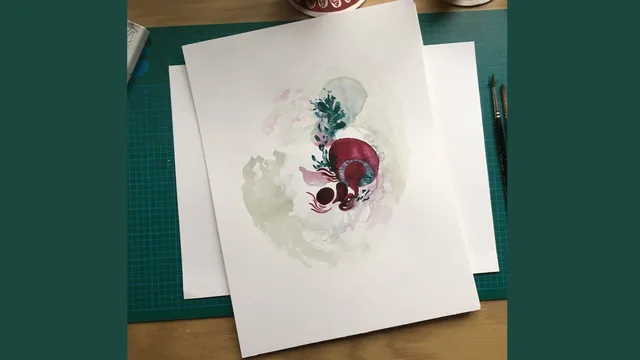
The improvisational half is the strongest section. Rather than a vague "just let go" pep talk, Wurm gives a concrete constraint: pick one brush, pick one color, make the first mark, and stop overthinking. She frames art-making as a series of choices and argues that reducing the number of choices reduces the fear that stalls people in front of blank paper. Watching her build a piece from a single crimson-and-Payne's-gray mixture, then expand into a broader palette on a second painting, demonstrates the idea rather than just asserting it. She also addresses a real and rarely-discussed problem, knowing when a piece is finished, admitting that this judgment only comes with repetition and that lingering on tiny details near the end is often anxiety in disguise rather than genuine refinement.
The planned method
The planned process section is shorter and less developed by comparison. It walks through thumbnail brainstorming (sketching several small compositional options before committing) and shows how a chosen thumbnail gets scaled onto watercolor paper. The most useful technical detail here is the complementary-color mixing: overlapping near-complementary red and green tones to create a muted, grayed neutral instead of reaching for black. That's a transferable painting principle worth the price of admission on its own. But the planned demonstration spends less time explaining the reasoning behind compositional choices than the freeform one did, and the thumbnail phase moves quickly enough that viewers hoping for a repeatable framework may come away with impressions rather than a system.
The bonus lesson on handmade mineral watercolors is a genuine extra rather than filler. Wurm demonstrates granulation, shimmer, and the way handmade pigment sits on the surface of the paper instead of sinking into it, comparing several colors from one small-batch brand. It's narrow in scope (one brand only) but honest about that limitation, and it gives colorists curious about the format a real sense of what they'd be buying.
Where the course falls short is depth of technique. This is not a class about composition theory, value structure, or how abstraction actually communicates mood beyond "make many paintings and notice patterns." Wurm says as much herself when she describes the goal as gathering data on what your own painting choices tend to produce, which is honest but leaves more advanced painters wanting more rigor. The pacing is unhurried, occasionally to a fault, with long uninterrupted painting sequences that reward patient viewers but could test those who want techniques delivered efficiently.
For a beginner who owns some watercolor supplies and feels stuck facing a blank page, this class delivers real, usable strategies: narrowing decisions, building a swatch reference, and using complementary mixing for depth. For anyone past that stage looking for structured color theory or a repeatable compositional method, it will feel more like an artist sharing her process than a technical curriculum.
The standout
The 'narrow your decision pool' technique, choosing just one brush and one color before starting, directly targets the blank-page anxiety abstract painting tends to provoke.
What you will learn
- How to distinguish natural versus synthetic brushes and pick sizes for washes versus precision marks
- How to build personal color swatch libraries from pans, tubes, and watercolor sheets so pigment choices are informed rather than guessed
- A freeform improvisational method that narrows decisions (one tool, one color) to reduce the anxiety of a blank page
- A planned method using thumbnail brainstorming before committing paint to paper
- How to use complementary colors (red and green) to gray and neutralize tones without mixing in black
- How handmade mineral watercolors behave differently from brand paints, including granulation and shimmer effects
Best for: Beginner to intermediate painters who already own basic watercolor supplies and want a low-pressure entry into abstraction rather than representational technique.
Skip it if: Anyone wanting rigorous color theory, structured exercises with rubrics, or a fast tutorial focused purely on finished, replicable outcomes.