
5 Minute Creativity: Drawing a Face in Proportion
Gabrielle Brickey · Portrait Artist - ArtworkbyGabrielle.com
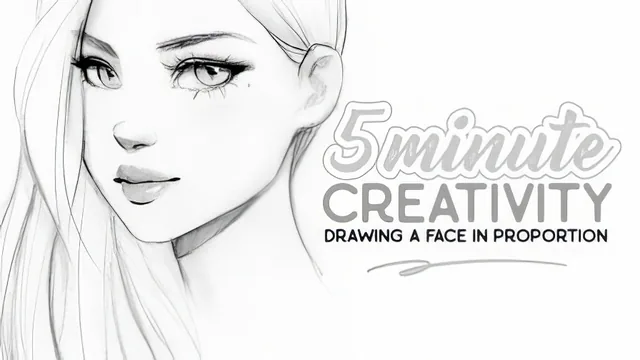
A three-minute proportion refresher that teaches one useful trick but stops well short of drawing an actual face.
Gabrielle Brickey's "5 Minute Creativity: Drawing a Face in Proportion" is exactly what its runtime promises: a short, single-lesson primer on head proportion, not a drawing tutorial. Nothing gets drawn from scratch here. Instead, the entire class is built around one idea, laid out in a straight-on view of a head, then confirmed again in three-quarter view.
The core method is a series of halving and thirding measurements. First, the vertical distance from the top of the skull to the bottom of the chin gets split in half to locate the eyes, with a useful caveat that beginners often miss: measure to the skull, not the top of the hair, since puffy hairstyles throw off the math. From there, the class introduces a second measurement, splitting the forehead-to-chin span into thirds to position the brow line and the bottom of the nose. A third pass takes the nose-to-chin distance and divides it again into thirds, this time to locate the part of the lips. Each step reuses the same halving-and-thirding logic, which makes the lesson easy to internalize even at this length.
Where the class earns its keep is in that final third measurement. Knowing that the lips sit roughly a third of the way down from the nose to the chin is a specific, checkable fact that a beginner can apply immediately to diagnose why a face "looks off," which is language the instructor uses directly. It is a small but genuinely diagnostic tool, the kind of thing that turns vague dissatisfaction with a drawing into a concrete fix.
The class is honest about its own limits. It explicitly states that these proportions only hold in a straight-on view and breaks down once the head tilts up or down, deferring that harder problem to another lesson entirely. It also acknowledges that stylized or cartoon work often pushes past realistic proportion on purpose, framing the grid as a baseline to depart from rather than a rule to obey. That kind of framing is more thoughtful than most quick tutorials bother with.
The tradeoff is scope. At three minutes, there is no demonstration of actually sketching a head, no discussion of the nose, ears, or hairline placement, and no coverage of tilted or profile views, which the instructor flags but does not teach. The class also leans on downloadable worksheets to do the practice work that the video itself does not have time for, so the real skill-building happens outside the lesson, not in it.
As a standalone piece, this works best as a refresher or an entry point rather than a complete lesson. It suits someone who already sketches faces occasionally and wants a fast proportional gut-check, or a total beginner looking for a low-commitment first exposure to facial anatomy before committing to a longer class. It is not for anyone expecting to walk away having drawn a face, or anyone who needs guidance on angles other than straight-on and three-quarter view. Given its brevity and its explicit positioning as a teaser for a fuller class, it is worth exactly the three minutes it asks for, no more and no less.
The standout
Splitting the nose-to-chin distance into thirds to pinpoint exactly where the lips should sit is the single most transferable measurement in the class.
What you will learn
- How to divide a head into halves to place the eyes at the vertical midpoint
- How to split the forehead-to-chin distance into thirds to position brows and the base of the nose
- How to divide the nose-to-chin space into thirds to place the lip line
- How the same proportional grid holds up in a three-quarter view
- When these proportions break down, specifically once the head tilts up or down
Best for: Beginners and hobbyist character artists who want a fast proportional checklist to fix faces that look subtly wrong.
Skip it if: Anyone wanting actual step-by-step face drawing instruction, feature rendering, or guidance on tilted or profile angles.