
30 Day Watercolor Challenge - Discover the Master Artist in You!
Zaneena Nabeel · Top Teacher | Artist
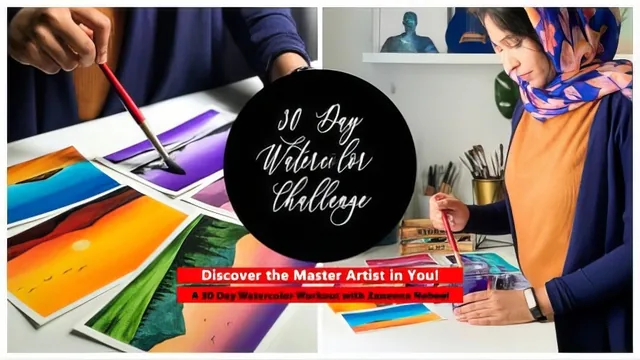
A prolific homemaker-artist walks you through 30 real landscape paintings, building watercolor fundamentals one guided project at a time.
What the course actually covers
The 30 Day Watercolor Challenge is exactly what the title promises: a daily sequence of landscape paintings, each roughly 20 to 30 minutes long, that starts with the simplest possible exercise and stacks new skills onto it. The opening days are built entirely around graded washes, teaching students to load a flat brush with diluted pigment and pull it in horizontal strokes from a dark top edge to a pale bottom, always working top-to-bottom or bottom-to-top so the blend stays clean. Mountains get layered on top of that wash once it dries, using a two-tone system: a lighter base color filled into a rough peak shape, then a second, slightly stronger mix of the same hue dropped along one edge to suggest shadow, with the rule that the shadow side has to stay consistent across every mountain in a scene.
From there the course introduces its more distinctive techniques. One sequence has students wet the entire sheet, drop in bands of contrasting color like turquoise and violet, then physically tilt the board in different directions so the pigments bleed into one another and form a gradient no brush could replicate. Another recurring device is the dry-brush pass: paint a solid black or indigo mountain shape, let it dry completely, then scrape a nearly-dry white-loaded brush across the surface to fake snow texture. The same dry-brush logic reappears for grass, distant tree lines, and cloud texture later in the sequence, so once a student learns it around day four or five, it becomes a repeated tool rather than a one-off trick.
Strengths and shortcomings
The pacing is the course's strongest asset. Because every project reuses techniques from a prior day, mountains, skies, and water each get revisited and refined rather than taught once and abandoned. Detail work, birds sketched as simple arced lines, a crescent moon dabbed in at the end, water reflections, is consistently saved for last, after the base washes have dried, which reinforces good sequencing habits for anyone new to the medium.
The instruction leans heavily on demonstration and repetition rather than technical explanation. Color mixes are described mostly by brand and product name rather than pigment properties, so a viewer without the same watercolor set has to substitute by eye. Structurally, the materials rundown up front covers paper weight, brush sizes, and palette organization clearly enough that a beginner can shop for the right supplies before starting. But the course rarely explains why a wash is graded a certain way beyond "it looks nice," so students hoping for color theory or compositional reasoning will come away with technique but not much conceptual grounding.
By the back half of the course, the projects grow more ambitious, layered snow-capped ranges with tree lines, a full sunset seascape mixing crimson and orange, without a corresponding jump in explanation, so the pacing that felt generous early on compresses noticeably. Anyone who sticks with all 30 days will finish with a stack of similarly sized, competently rendered landscapes and real comfort with wash control, wet-into-wet blending, and dry-brush texture, even if the underlying theory stays thin throughout.
The standout
The wet-into-wet sky exercise, where diluted pigment is dropped onto soaked paper and the paper itself is tilted in every direction to blend colors, is a genuinely transferable technique worth the price of admission alone.
What you will learn
- How to lay down a smooth graded wash from a single pigment, controlling water ratio for light-to-dark blends
- How to mix and layer simple mountain silhouettes using violet, indigo, and other custom-mixed hues at increasing tonal contrast
- How to create wet-into-wet sky blends by tilting the paper to let vibrant colors flow and merge naturally
- How to use dry-brush technique with white gouache or watercolor to add snow texture over a dried, saturated background
- How to compose layered scenes (birds, trees, reflections, moons) as fine detail work added after base washes fully dry
- How to build a consistent daily art practice using a fixed paper size and a repeatable painting workflow
Best for: Absolute beginners who want daily, bite-sized landscape projects and don't mind a repetitive format to build muscle memory fast.
Skip it if: Anyone past the beginner stage, or anyone who dislikes rambling verbal narration and wants tight, edited demonstrations instead.